When the Exam Prompt Says "Motif" and You Freeze
There is a specific kind of dread that hits when an IB English Paper 1 exam paper flips open, the guiding question explicitly asks about motifs, and your mind goes blank.
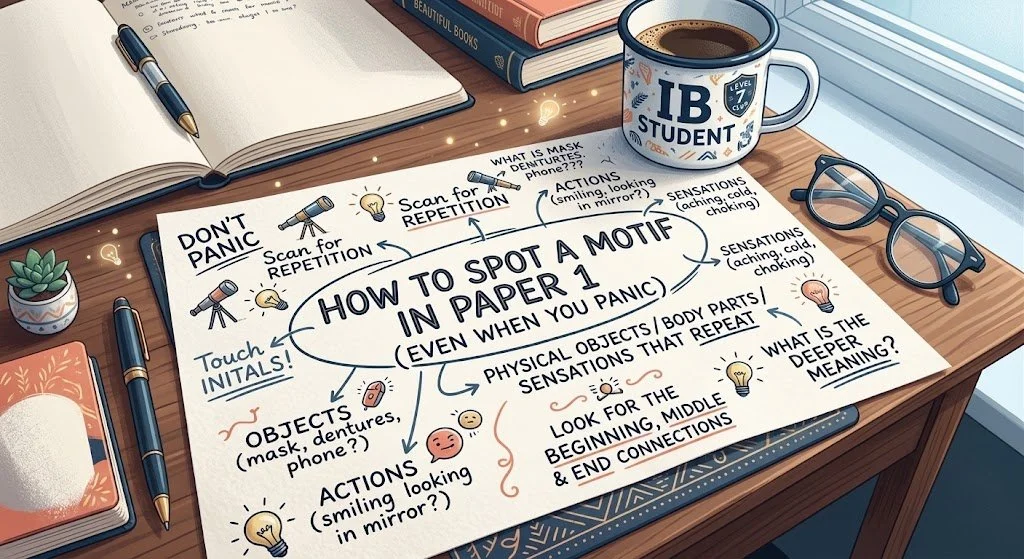
Many students panic because they treat a "motif" like an invisible, academic secret hidden inside the text. But here is the inside scoop: a motif is almost always just a physical object, body part, or sensation that keeps popping up.
Does this work for both Fiction & Non-Fiction Texts? Absolutely. Whether you’re working on a literature (like a poem, a short story, a play, or a novel) or language (like an article, a comic strip, an advertisement, a speech, and so many more text types), writers use the same technique when it comes to motifs.
Step 1: Finding the Motif (The "3-Pass" Scanning Method)
If you have "no idea" how to spot a motif under exam pressure, take two minutes to run these quick physical checks across the passage:
The Object Pass: What physical item appears at least twice? (e.g., fiction: a mask, mirror, or dentures; non-fiction: a passport, a microphone, a recurring clock, or a specific landmark)
The Body Pass: What physical action or facial expression repeats? (e.g., fiction: smiling, hiding the face; non-fiction: an author adjusting their posture, looking at their hands, or a repeated tone of voice in a speech)
The Sensation Pass: What physical feeling keeps being mentioned? (e.g., fiction: suffocating or aching; non-fiction: heat in a travelogue, oppressive noise in an urban editorial, or exhaustion in a memoir)
Rule of Thumb: If an item, body part, or physical sensation appears in the beginning, middle, AND end of the text, that is your motif.
Step 2: Writing About It (The "Beginning-Middle-End" Formula)
Once you spot the repeating physical detail, writing the essay becomes much easier. The trick to a top-band score is showing how the motif's meaning changes across the narrative arc—or the author's real-world argument.
Paragraph 1 (The Beginning): How does the motif introduced in the opening set up the central conflict, insecurity, or core thesis? (In non-fiction: How does the object frame the author's initial perspective or real-world problem?)
Paragraph 2 (The Middle): How does the motif shift, cause tension, or develop deeper meaning as the text progresses? (In non-fiction: How does the author return to this image to build their commentary or persuasion?)
Paragraph 3 (The Ending): How does the motif reach a resolution, collapse, or get discarded at the climax? (In non-fiction: How does the final appearance of the motif deliver the author's ultimate purpose or call to action?)
See It in Action:
Look at the sample fiction text below from Shazia Yousuf’s short story “A Mouthful of Silence” (2026), published in The Hyphen, an online literary journal dedicated to translations of contemporary South Asian literature.
The guiding question asks:
"How does the author use motifs to convey the protagonist's complex emotional journey?"
In the accompanying exemplar essay, notice how the response doesn't overcomplicate it. It simply picks three clear physical motifs (the protective mask, the aching smile, and the oppressive dentures) and tracks how Meema's relationship with each one shifts from hiding, to painful performance, to final emotional release.
Use the sample response below to model how spotting motifs can turn a scattered commentary into a focused, top-band essay.
Paper 1 Practice
1. Write a guided analysis of the following text.
The following text is an extract from the short story “A Mouthful of Silence” by Shazia Yousuf (translated by Zahid Rafiq), set in Kashmir. Meema, a woman who has suffered lifelong shame due to her physical appearance, visits a dentist in Dalgate to undergo a major transformation.
__________
It took a month. One at a time, or sometimes two in a sitting, all the teeth were removed. An epidemic had spread and no one was allowed to walk without a mask. Meema thanked God that no one would see her. She went to the doctor, or anywhere at all, wearing a mask. And when she was home, she neither received a guest nor showed herself to anyone. “This is not such a big thing, after all,” she thought to herself, “Why didn’t I get this done before. I suffered so much and dragged my family with me.”
It seemed as though Monday would never arrive but then it did. Meema had the first appointment. After a long exchange of pleasantries, the doctor brought the dentures. Meema leaned back on the doctor’s chair, her mouth open, staring at the dust hanging from the ceiling fan. She felt like cleaning the fan with a long broom. “Open wider,” the doctor said, and Meema obliged, her eyes opening wider too. After a little while, the doctor asked Meema to look into the mirror. Meema blushed at her reflection. She wanted to laugh and cry at the same time. Had she stayed on for a while more, she probably would have cried. So she hurried away.
Outside the clinic, Abdul Majeed flagged an auto but Meema said, “Let’s walk. Won’t take long to Dasgeer Saeb’s.” She walked with long strides and under the mask, she felt her teeth with the tip of her tongue. The bucket of yellow rice was empty no sooner than she had taken off the lid. She gave alms, prayed alone at the far end, and got halwe-paratha for the children. On the other side of the road, a woman sold fish-fingerlings, and Meema told her husband she would make a fingerling chutney for lunch. Without bargaining, she bought a kilo. At home the children ran after Meema. She laughed happily. They had tea with the halwe-paratha she had bought at the shrine. Her gums ached but she tried not to think about it. She left the cups unwashed and turned to clean the fish-fingerlings.
Next morning, while everyone was still asleep, Meema prayed on the prayer-rug, read the Quran, and put on her dentures while sitting on the rug itself. She reached out to the mirror that always stood on the window sill. “Meema is shining, Meema is beaming,” she remembered her kids teasing her from the night before and she couldn’t hold back her laughter. She did look good. She looked at the right side of her face, then turned to look at the left. Her smile was so wide that she could see her molars in the mirror and her cheeks ached. When was the last time she had laughed so freely? She prostrated once more, and got up.
The day was bright and warm, an early spring day. Meema had washed a heap of clothes early in the morning and now lay in the kitchen with the traditional kanger, a wicker pot with burning charcoal, against her chest. There was a knock at the door. It was her youngest cousin, standing in the alleyway.
“Meema aunty, they are asking you to come,” he shouted, “Grandmother passed away.” Naane, her grandmother had been dying for a long time; Meema knew that one day the news would arrive. And yet, she lost her control and began to bang her chest...
The auto kept moving, and the road seemed longer than ever, yet Meema felt she was getting nowhere. Naane's face filled her thoughts. The last time she had seen the old woman, she had lain curled beneath the blankets like a hen.
“Meema Lalai, ask God to free me now,” she had said. “And when the day comes, don't cry.”
So many people had gathered at Meema's mother's house that the auto had to drop her at the end of the street. Groups of young and old men lingered in the alley, waiting to offer the funeral prayers. Hundreds of pairs of shoes crowded the veranda.
Naane lay in the guest room, her head turned towards the Kaaba. The moment Meema saw her, she lurched forward and threw herself over her grandmother's body. The room was filled with women wailing at the top of their voices. Only Meema remained silent. Her two sets of teeth would not let her open her mouth. She tried to cry out loud, but no sound came. The new teeth hurt as though they belonged to someone else, and her gums ached as if tiny knives were lodged beneath them.
Meema felt she was choking, and her heart felt as though it would burst. Her hands reached the dentures, she took them out and dropped them into the pockets of her pheran. Then, the whole neighbourhood heard her wails.
“Naanai, are you free now, Naanai, are you free now.”
Yousuf, S. (2026, July 22). A mouthful of silence.
Hyphen. https://the-hyphen.in/article/a-mouthful-of-silence
– How does the author use motifs to convey the protagonist's complex emotional journey?
_______________
Dalgate: lake in Srinagar, Kashmir
Dasgeer Saeb’s: holy Sufi shrine
halwe-paratha: sweet fried bread treat
kanger: portable charcoal hand warmer.
Naane / Naanai: grandmother
Lalai: term of endearment
Kaaba: sacred Islamic sanctuary in Mecca
Pheran: traditional cloak worn by both men and women