Paper 1: Crit C — Beyond “Firstly” and “Moreover”
from David Ogilvy: Biography, Books on Advertising, and Key Quotes from the Father of Modern Advertising
IBDP Paper 1 Criterion C
Crit C: Coherence, focus and organisation basically asks: Does the essay stay focused, make sense, and move smoothly from one idea to the next?
Transitions like “Firstly,” “Secondly,” and “Moreover” might have been enough to show organisation in the past. But that kind of linking can feel a bit mechanical to modern day readers. Stronger Paper 1 essays use organic transitions, meaning each paragraph feels like it naturally grows out of the one before it, instead of sounding like a list of separate points.
That is one reason the essay below scored well on Criterion C: each paragraph builds on the previous paragraph. The essay moves from tourists, to business-minded readers, to educated middle-class readers in a way that feels logical and easy to follow, rather than forced.
Criteria A, B, C
The essay also does well in other ways:
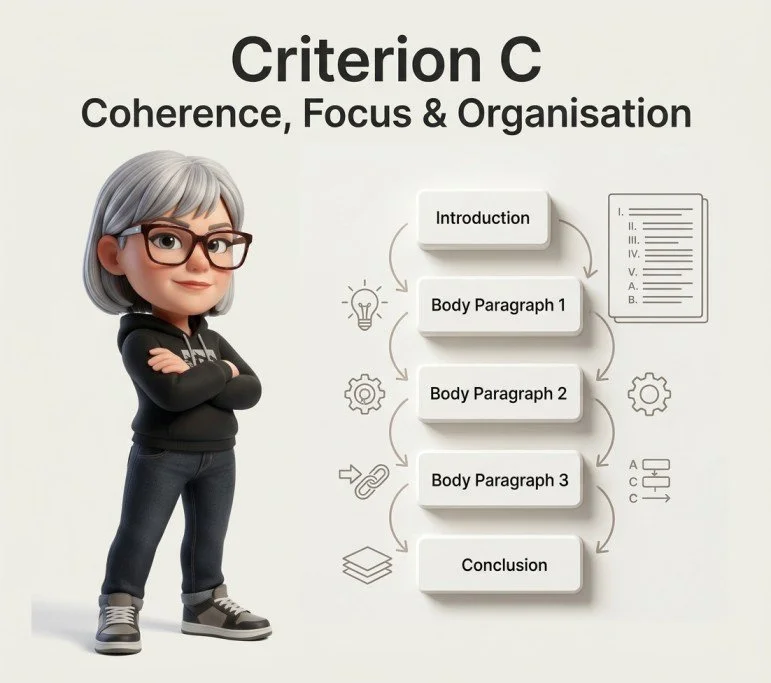
Criterion C
Each topic sentence make the key language of the guiding question more precise so that the reader knows exactly which audience or persuasive strategy is being discussed.
Criterion C: The essay is clearly focused, organised, and easy to follow.
Criterion A
Each claim is backed up with evidence from the advertisement.
Criterion A: The essay supports interpretations with references to the text.
.

Criterion B
Each claim is followed by analysis that explains why that evidence matters.
Criterion B: The essay shows the student is not just spotting features, but explaining how they shape meaning.
At the end of each body paragraph, the essay evaluates how successfully the advertisement attracts a specific audience.
Criterion B: The essay evaluates the effect of the advertisement’s choices.
Exemplar Paper 1 Essay
As you read the essay below, notice how the paragraphs connect and how each point flows naturally into the next. That kind of structure is what helps an essay feel well organised and reach the higher bands.
Text 1
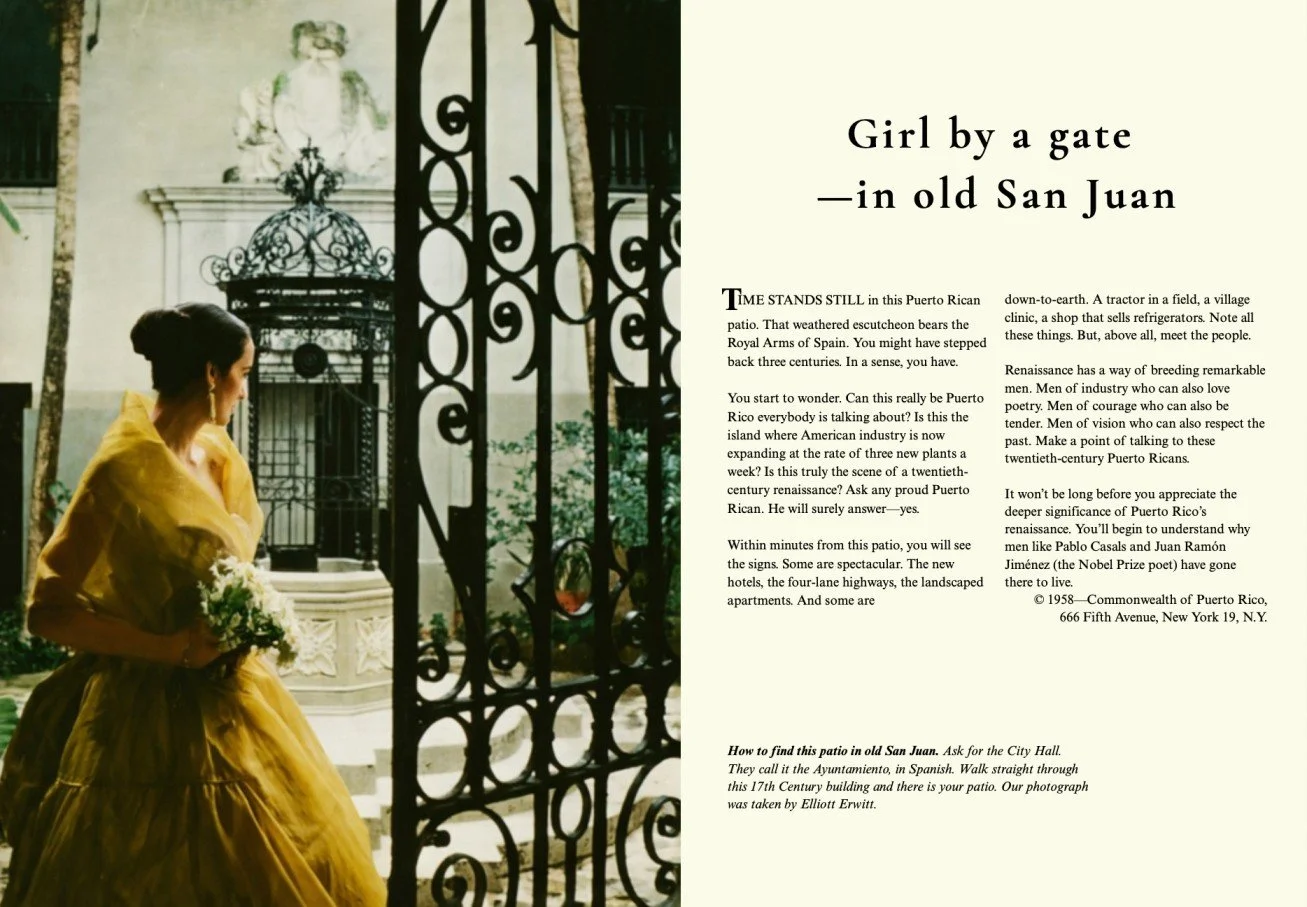
“Girl by a gate—in old San Juan” was published in 1958 as part of a Puerto Rico tourism campaign and appeared in upscale U.S. magazines such as The New Yorker.
– How and to what effect do language and image work together to persuade multiple audiences?
In the late 1950s, Puerto Rico was being advertised to mainland Americans as a place where colonial beauty and modern progress existed side by side. The advertisement “Girl by a gate—in old San Juan,” published by the Common-wealth of Puerto Rico in 1958, uses both romanticised visual imagery and persuasive article-style copy to persuade an American audience, especially tourists, businesspeople, and educated middle-class consumers, to see Puerto Rico as historic, culturally rich, and economically modern. The purpose of the advertisement is to attract mainland American interest in Puerto Rico by promoting it as a destination for travel, investment, and admiration. Its central message is that Puerto Rico is experiencing a twentieth-century “renaissance” in which historic tradition and cultural identity coexist with modern industrial development.
This careful balance between past and present is first established through the ad’s romantic treatment of Puerto Rico’s history, as the advertisement’s historical language and romantic image work together to present Puerto Rico as desirable for tourists. The headline, “Girl by a gate—in old San Juan,” creates a poetic, story-like mood because it sounds more like the title of a painting or short story than a straightforward advertisement. The simple nouns “Girl” and “gate” make the scene feel symbolic and mysterious, while the phrase “old San Juan” directs attention to the city’s historic identity rather than to modern tourism. This encourages the reader to approach Puerto Rico as a place of romance and cultural depth. The copy develops this impression through the metaphor “time stands still,” which suggests that the Puerto Rican patio has preserved its historic atmosphere despite the passage of time. As a result, the patio seems peaceful, memorable, and connected to the past, allowing readers to imagine experiencing history directly. The reference to the “Royal Arms of Spain” further strengthens this effect through historical allusion, pointing to Puerto Rico’s Spanish colonial past and giving the setting a sense of inherited prestige. This historical appeal is reinforced visually through the mise-en-scène: the woman’s yellow dress, the flowers, the pale architecture, and the ornate black gate create a carefully arranged scene of elegance and beauty. Together, these choices appeal to mainland American tourists by presenting Puerto Rico as culturally rich, romantic, and historically meaningful.
Having made Puerto Rico desirable to tourists through romance and history, the advertisement then makes that desire practical by presenting the island as accessible and easy to visit. The closing note uses direct address in “your patio” and imperatives such as “Ask for the City Hall” and “Walk straight through,” making the scene feel like a real place the reader could personally find rather than a distant fantasy. Visually, the gate creates a framing or threshold effect by partially enclosing the woman and courtyard while still allowing the viewer to look inside, placing the reader just outside the scene. This perspective suggests that the viewer is not merely observing Puerto Rico from afar but is being invited to cross into it. The girl’s sideways gaze also directs attention deeper into the space, encouraging curiosity about what lies beyond the frame. Together, the practical directions and open visual frame make Puerto Rico seem both intriguing and reachable, appealing especially to tourists who want a destination that feels within reach.
However, the advertisement presents this historical beauty alongside signs of change, using the language of modernizationand economic expansion to persuade readers that Puerto Rico is commercially promising. The article uses rhetorical questions when it asks whether this is “the island where American industry is now expanding” and whether Puerto Rico is the scene of a “twentieth-century renaissance.” These questions guide the reader from the old patio in the photograph toward a wider image of national progress, making modernization feel surprising but convincing. The word “renaissance” is especially persuasive because it suggests not just economic growth, but cultural rebirth and renewal. The copy then makes this progress more concrete through statistics, stating that American industry is expanding at “the rate of three new plants a week.” This precise figure makes economic growth seem factual and impressive, appealing to readers looking for evidence of business potential. The semantic field of development also appears in references to a “tractor,” a “village clinic,” and “refrigerators,” which shifts progress from abstract industry to practical improvements in agriculture, healthcare, and consumer life. Alongside this, the listing of “new hotels,” “four-lane highways,” and “landscaped apartments” suggests that modernization is widespread, visible, and useful for tourists, residents, and investors alike. Although the photograph does not show factories or machines, its visual order supports this message: the old ironwork and historic architecture are paired with a polished, modern fashion-style photograph, while the vertical lines of the gate, the balanced placement of the woman, and the calm courtyard setting create a sense of stability and confidence. Together, the text and image make Puerto Rico appear balanced, combining heritage with economic opportunity, reassuring business audiences that Puerto Rico is moving confidently into the modern world and is welcoming to enterprise.
The advertisement does not rely only on economic appeal, though. It also presents Puerto Rico as culturally rich, broadening its attraction beyond business interests through cultural language and refined image. The article uses cultural allusion and name-dropping by referring to “Pablo Casals and Juan Ramón Jiménez,” connecting the island to internationally respected artists and intellectuals. These references give Puerto Rico cultural authority because they associate the island with high art, music, literature, and global prestige rather than only tourism or industry. The copy also uses parallelism in phrases such as “men of industry who can also love poetry” and “men of vision who can also respect the past.”, presenting industry and art as compatible through its repeated structure, to suggest that Puerto Rico’s modernisation has not erased its historical awareness. The photograph reinforces this refined cultural image through the woman’s formal dress, graceful pose, bouquet, and ornate setting, all of which make the scene appear tasteful and composed. Together, the prestigious references and elegant visual presentation construct Puerto Rico as a sophisticated cultural society. This persuades educated middle-class readers to admire Puerto Rico intellectually and artistically.
Overall, the advertisement appeals to different kinds of audiences by using different persuasive strategies. Tourists are drawn to Puerto Rico through the romantic photograph, historical language, and direct invitation to visit; business-minded readers are targeted through claims of industry and development; and educated middle-class readers are addressed through references to culture and famous artists. While the ad successfully persuades these multiple audiences to see Puerto Rico as historic, modern, and cultured, it may also dissuade some readers because its polished image and confident language feel too selective. Business-minded readers might question whether the promise of rapid industrial growth is being exaggerated, while more critical or educated readers might notice that the ad avoids problems such as poverty, inequality, and Puerto Rico’s colonial relationship with the United States. As a result, the advertisement’s idealized version of Puerto Rico may seem attractive, but not fully trustworthy.