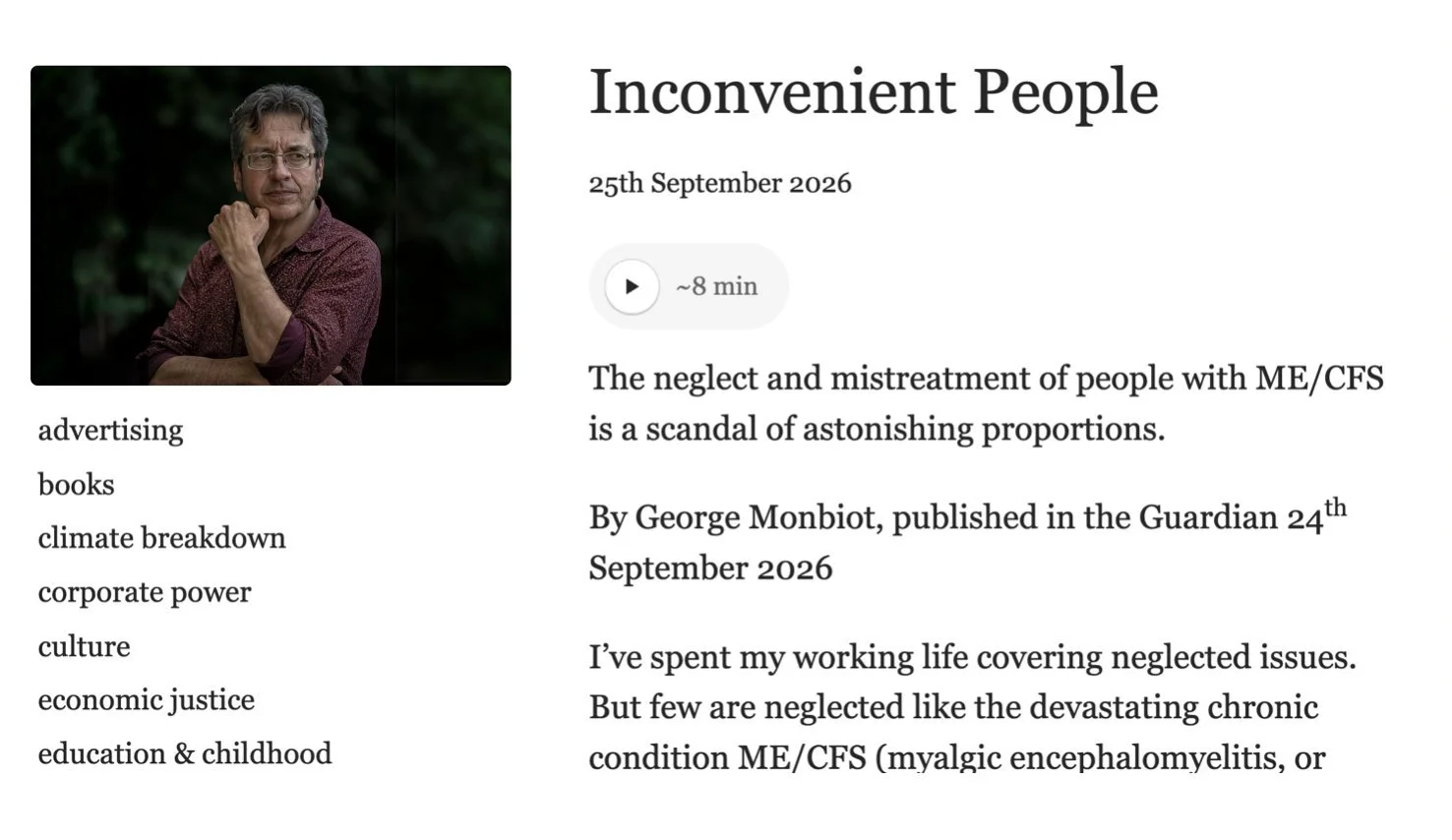
Read the full blog here.
Why Structure Matters
In Paper 1, examiners are looking for your understanding of individual language devices as well as your understanding of how the whole text is organised. Structure matters because it shows how the writer leads the reader through the text.
Writers choose what to introduce first, what to develop next, and what idea to end with. By analysing structure, you can explain how the writer builds their message and guides the reader towards a particular response.
Writing About Structure
When writing about structure, focus on how the writer organises ideas. Do not just look at individual words or techniques. Ask yourself: What does the writer begin with? What do they move on to? Why is this order important?
Monbiot’s Blog Structure
In Monbiot’s extract from “Inconvenient People”, the structure helps him persuade the reader. He begins by showing how serious ME/CFS is. Then he shows how sufferers have been ignored. After that, he includes patients’ testimonies and statistics to make the issue feel both personal and large-scale. Finally, he criticises institutions such as the media, politicians, and medical authorities.
This movement is important because the reader is first made to understand the illness, then feel sympathy for sufferers, and finally feel anger at the systems that have failed them.
Signposting
Useful phrases include:
The writer begins by…
The focus then shifts to…
This develops the argument by…
The structure moves from… to…
By ending with…, the writer leaves the reader with…
For example, you could write:
Monbiot’s structure moves from personal suffering to wider institutional failure, helping the reader see ME/CFS as both an individual tragedy and a public scandal.
Overall, writing about structure means explaining how the order of ideas helps the writer achieve their purpose.
Exemplar Essay
This essay is based on an extract from George Monbiot’s blog “Inconvenient People,” beginning with “I’ve spent my working life…” and ending with “…sometimes incapable of almost all movement.”
Note, The length of this essay goes beyond the 1 hour and 15 minute Paper 1 time allotment. Its purpose is to provide a wide range of examples of language analysis that the text offers, rather than to model the exact length expected in timed exam conditions.
– How does the writer use language and structure to achieve their purpose?
In the extract from “Inconvenient People”, George Monbiot argues that people with ME/CFS have been neglected and mistreated by society, the media, politicians, and medical institutions. Writing for a socially conscious readership, his purpose is to expose this neglect as a serious moral injustice and to persuade his audience to recognise ME/CFS patients as victims of institutional failure rather than exaggeration or weakness. To achieve this purpose, Monbiot uses emotive diction, metaphor, direct quotation, statistics, contrast, and historical framing. By shaping the topic as both a human tragedy and a public scandal, he guides the audience towards seeing the treatment of ME/CFS patients as unacceptable and in need of urgent accountability.
Monbiot first establishes the seriousness of the illness through contrast, emotive diction, and listing. He begins by stating, “I’ve spent my working life covering neglected issues. But few are neglected like the devastating chronic condition ME/CFS.” The conjunction “But” immediately separates ME/CFS from other neglected issues, suggesting that this condition has been ignored to an exceptional degree. At the same time, the adjective “devastating” frames the illness as severe and life-changing rather than minor or exaggerated. Monbiot then develops this idea by explaining that ME/CFS can prevent people from “working, socialising and, sometimes, even moving or eating.” The list intensifies as it moves from ordinary daily activities to basic physical needs, allowing the reader to understand the illness through concrete losses. As a result, ME/CFS is presented not simply as fatigue, but as a condition capable of destroying a person’s independence. In this way, Monbiot makes the illness understandable in human terms, persuading the audience to accept its seriousness before he turns to society’s neglect of sufferers.
Having established the severity of ME/CFS, Monbiot then shifts from the illness itself to the way sufferers have been socially erased. He describes people with ME/CFS as having been “airbrushed from our minds,” a metaphor that suggests deliberate removal, as if patients have been edited out of a photograph. This choice of verb makes the neglect seem almost intentional, rather than accidental. It also links closely to the title, “Inconvenient People,” since it implies that society removes these patients from view because their suffering is uncomfortable to acknowledge. Through this metaphor, Monbiot prompts the audience to feel implicated in the neglect, presenting forgetfulness not as innocent ignorance but as a collective moral failure.
Monbiot then gives this neglect a human voice through direct quotation and cumulative structure. He includes short testimonies such as “I’ve just been completely abandoned,” “a 10-year waiting list for treatment,” and “stuck in limbo,” allowing patients to speak for themselves rather than being described only by the writer. These brief fragments make the issue more immediate and personal: emotive diction “completely abandoned” suggests total isolation, while idiom “stuck in limbo” presents patients as trapped without progress. The semicolons between the quotations create a rapid sequence of voices, giving the impression that suffering is accumulating. This effect is reinforced when Monbiot says he was “inundated with horrifying testimonies,” using the metaphor of a flood to suggest that these experiences are overwhelming in number. By arranging the testimonies as a chorus of repeated distress, Monbiot persuades the audience to trust the sufferers’ experiences, since disbelief becomes harder to maintain in the face of so many similar accounts.
After making the suffering personal, Monbiot broadens the issue through statistics, shifting from individual testimony to social scale. He states that “an estimated 400,000 people” in the UK live with ME/CFS and that the condition affects women by “a ratio of about 4:1.” These figures introduce a more factual tone, showing that the article is not based only on isolated personal stories but on a wider public reality. The statistic about women is especially important because it prepares the reader for Monbiot’s later reference to female illnesses being dismissed as “hysterical.” In this way, the statistics strengthen the emotional testimonies rather than replacing them, persuading the audience to see ME/CFS as both personally painful and socially significant.
Once the scale of the issue has been established, Monbiot turns his criticism towards public institutions by using contrast. He writes, “You might have imagined politicians and the media would be all over it. Instead, this great social crisis is met with silence or worse.” The phrase “You might have imagined” creates an expectation that a problem of this size would naturally receive political and media attention. However, the discourse marker “Instead” creates a sharp contrast, reversing the reader’s expectation and exposing the gap between what should happen and what actually occurs. The ellipsis “silence or worse” suggests that institutions are not only failing to respond, but may also be deepening the harm in ways too broad or troubling to list fully. Monbiot reinforces this criticism through the evaluative verbs “mocked” and “trivialised,” which present the media as dismissive and irresponsible. Through this juxtaposition between expected concern and actual neglect, Monbiot persuades the reader to see institutional inaction as shocking rather than normal.
This institutional criticism deepens when Monbiot places the issue within a longer historical and financial frame. He writes, “There’s a long, dark history here,” which creates a serious and ominous tone, the adjectives “long” and “dark” suggesting that the problem is deeply rooted and morally troubling. He connects ME/CFS to the dismissal of mainly female illnesses as “hysterical.” The quotation marks distance Monbiot from the term, showing that he is criticising it, persuading the reader to see the treatment of ME/CFS patients as part of a wider pattern of sexism in how women’s pain has been judged. Monbiot then adds that if a condition is blamed on “malingering, poor self-care or a negative attitude,” institutions “won’t have to cough up.” The list underscores how blame is shifted onto patients, while the informal phrase “cough up” suggests that governments and insurers may benefit financially from disbelief. By linking medical dismissal to both prejudice and money, Monbiot persuades the audience to question whether official scepticism is truly objective.
Finally, Monbiot challenges medical authority through evaluative language, antithesis, and personification. He describes the studies supporting CBT and GET as “deeply flawed” and “comprehensively discredited,” using intensifying adverbs and evaluative diction to undermine their credibility. He then says that GET is “not only useless but actively dangerous.” The structure “not only…but” creates escalation, showing that the treatment is worse than ineffective because it can cause harm. Monbiot explains that PEM “robs people of their remaining energy,” personifying the symptom as a thief. This makes the suffering seem violent and cruel. The final visual imagery of patients becoming “bedbound” and “incapable of almost all movement” leaves the reader with a clear image of physical damage. By ending this section with the consequences of harmful treatment, Monbiot persuades the audience that institutional misunderstanding can directly worsen patients’ lives.
Overall, Monbiot uses both language and structural features to make ME/CFS visible as an injustice. His metaphors suggest erasure, his quotations create a chorus of suffering voices, his statistics add credibility, and his structure moves from personal suffering to wider institutional failure, allowing the reader to see ME/CFS as both an individual tragedy and a public scandal. However, the text’s persuasiveness is slightly limited by the imbalance in how the article is engineered. Its heavy reliance on pathos, through emotive diction and distressing testimonies, powerfully pushes the audience towards outrage and belief in institutional failure, an effect Monbiot deliberately constructs. At the same time, the extract reflects how persuasive media texts often foreground emotional appeal to shape public concern, prioritising moral urgency over a full exploration of opposing viewpoints.