IB English Paper 2 — Exemplar Essay
IB English Past Paper May 2025 TZ3
Question 1 - How do two works you have studied explore the notion of change?
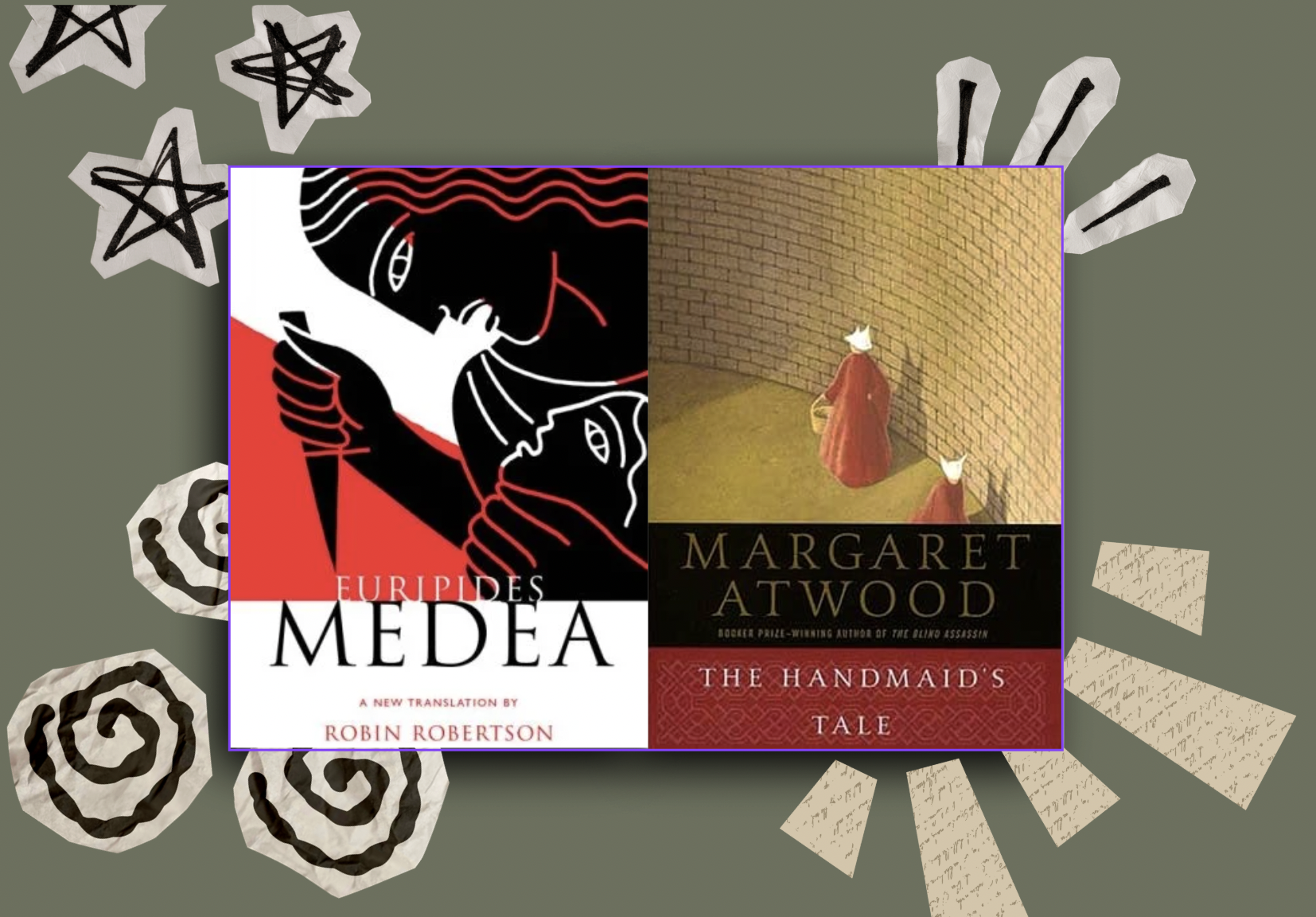
[INTERPRET THE PROMPT] Both Euripides’ Medea and Margaret Atwood’s The Handmaid’s Tale explore change as a powerful force that reshapes individuals and societies. [CONTEXTS] Although written more than two thousand years apart, both texts question how patriarchal and political systems construct identities that prove unstable under pressure. [WORK 1’S APPROACH] In Medea, change is sudden and explosive, triggered by betrayal within a rigid Greek society, and unfolding with a sense of tragic inevitability typical of classical drama. [WORK 2’S APPROACH] In The Handmaid’s Tale, change unfolds more gradually, showing how democratic freedoms can be eroded by authoritarian rule. [TOPICS] Through their portrayals of [1] personal transformation, [2] societal corruption, and [3] the rejection or erasure of imposed roles, [THESIS] both writers suggest that change exposes weaknesses already embedded within social systems and the fragility of imposed identities.
[TOPIC [1] – COMPARATIVE INTERPRETATION] Both Euripides and Atwood show how oppression drives personal transformation, though the nature of that change differs significantly. [POINT] In Medea, Euripides presents transformation as abrupt and extreme, emerging through a dramatic rupture in identity. [ANALYSIS] He contrasts Medea’s earlier devotion, when she reminds Jason, “I saved your life,” with her later declaration, “I will kill my children.” [INTERPRETATION] This stark juxtaposition highlights the extremity of her transformation from loyal wife to avenger, suggesting that betrayal and exile have fundamentally reshaped her identity, while also reflecting the sense that her fate follows the tragic pattern already set in motion. Yet this transformation also raises the question of whether Medea is reclaiming agency or becoming consumed by the very rage that oppresses her. [EVALUATION] For the audience, this shift is deeply unsettling, destabilising moral expectations and compelling them to confront the destructive consequences of systemic oppression, even as the structure of tragedy makes her actions feel disturbingly unavoidable.
[COMPARATIVE POINT] In The Handmaid’s Tale, however, Atwood presents transformation as gradual and internalised rather than explosive. [ANALYSIS] Through the dehumanising image, “We are two-legged wombs, that’s all: sacred vessels, ambulatory chalices,” women are reduced entirely to reproductive function. [INTERPRETATION] This metaphor reflects Gilead’s ideology, revealing how language itself becomes a mechanism of control that reshapes identity from within, while Offred’s reflective narration shows that she understands this erosion more clearly in hindsight than in the moment. [EVALUATION] The reader experiences anger and discomfort, while also recognising how sustained ideological conditioning can erode individuality without immediate resistance, prompting questions about how much control an individual can realistically maintain within such a system. At the same time, Offred’s measured tone complicates any clear distinction between quiet resistance and quiet resignation. [COMPARATIVE EVALUATION] While Medea’s change erupts outwardly in violence and Offred’s manifests as enforced submission, both texts ultimately reveal that oppressive systems distort identity, though the form that distortion takes is shaped by context and genre.
[TOPIC [2] – COMPARATIVE INTERPRETATION] Both texts also examine broader societal change, revealing how moral corruption develops within political structures. [POINT] In Medea, Jason’s transformation into a self-serving opportunist reflects the patriarchal values that enable him. [ANALYSIS] His claim that his remarriage was undertaken “for your own good, as well as mine,” is delivered in calm, rational language, as though betrayal can be justified logically. [INTERPRETATION] Euripides highlights the gap between Jason’s rhetoric and his ethical failure, encouraging the audience to see the emptiness of his reasoning, the moral blindness built into the authority he represents. [EVALUATION] This contrast destabilises the audience’s trust in patriarchal authority, exposing how systems of power can cloak moral corruption in the language of reason and civic duty.
[COMPARATIVE POINT] Similarly, Atwood presents the rise of Gilead as gradual rather than sudden. [ANALYSIS] Offred reflects that “nothing changes instantaneously: in a gradually heating bathtub you’d be boiled to death before you knew it,” using an extended metaphor to illustrate imperceptible political decline, reinforced by the reflective tone of retrospective narration. [INTERPRETATION] This metaphor suggests that freedoms can be eroded incrementally, with hindsight exposing the danger only once resistance is no longer possible, complicating the line between being a victim of the system and passively enabling it. The metaphor also implies that ordinary individuals may be implicated in sustaining the very systems that later oppress them. [EVALUATION] By framing political collapse as slow and almost invisible, Atwood unsettles the reader’s sense of security, compelling them to question their own complacency and recognise how easily democratic stability can erode unnoticed. [COMPARATIVE EVALUATION] While Euripides stages moral decay within the intimate sphere of family and city-state, Atwood expands it to a national level; in both cases, change exposes the fragility of systems that once appeared stable and legitimate.
[TOPIC 3 – COMPARATIVE INTERPRETATION] Finally, both texts explore change through the rejection or erasure of socially imposed roles, particularly those assigned to women. [POINT] In Medea, Euripides presents Medea’s rejection of her socially imposed maternal role through her explicit acknowledgement of internal conflict. [ANALYSIS] When she admits, “I know what evil I am about to do, but my anger is stronger than my deliberations,” the balanced phrasing and rational diction emphasise her conscious awareness of the crime she is about to commit. [INTERPRETATION] This self-awareness suggests that the murder of her children is not impulsive but deliberate, framing her rejection of motherhood as a calculated assertion of agency within a society that denies her legitimate power, though that assertion ultimately distances her from the human connection she seeks to reclaim. [EVALUATION] As a result, the audience is both disturbed and intellectually unsettled, compelled to reconsider the stability of idealised maternal roles and the extent to which oppressive structures contribute to their destruction.
[COMPARATIVE POINT] In contrast, Atwood presents identity not as violently rejected but systematically suppressed. [ANALYSIS] Through the recurring motif of naming, Offred confesses, “My name isn’t Offred, I have another name, which nobody uses now because it’s forbidden,” foregrounding the imposed nature of her patronymic identity. [INTERPRETATION] The concealment of her real name symbolises both the regime’s attempt to erase individuality and the quiet persistence of selfhood beneath enforced labels, leaving open the question of whether remembering one’s identity is an act of resistance or simply a means of psychological survival. [EVALUATION] Readers experience the psychological strain of this imposed anonymity, yet are also prompted to recognise how identity can survive internally even when externally silenced, complicating assumptions about submission and resistance. [COMPARATIVE EVALUATION] While Medea destroys her prescribed role and Offred preserves an inner self beneath hers, both texts ultimately suggest that identities imposed by oppressive systems cannot remain stable or uncontested.
[RESTATED COMPARATIVE THESIS] Ultimately, both Medea and The Handmaid’s Tale present change as an inevitable response to systems that deny autonomy and equality. [TEXT 1 – SUMMATIVE INTERPRETATION] Euripides portrays transformation as immediate and catastrophic, exposing how patriarchal injustice can provoke destructive retaliation. [TEXT 2 – SUMMATIVE INTERPRETATION] Atwood, on the other hand, presents change as slow and institutional, warning that freedoms are often lost incrementally rather than all at once. [FINAL COMPARATIVE BROADER SIGNIFICANCE] Despite differences in genre and context, both works suggest that when autonomy is suppressed, transformation becomes inevitable, exposing both the fragility of systems and the moral complexity of resistance. Yet neither text suggests that such change guarantees justice, leaving its consequences unresolved.