IB English Paper 2 — Exemplar Essay 25/25
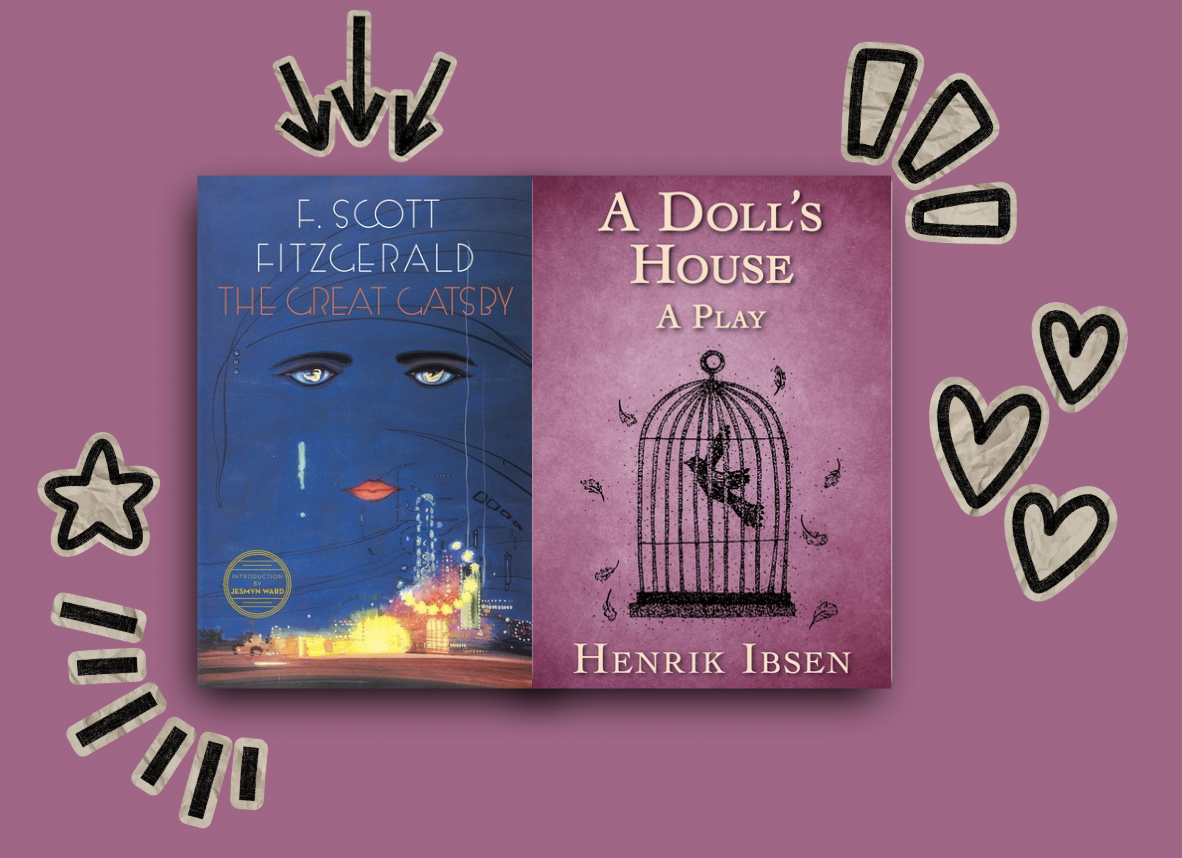
Minor characters, even though they appear less frequently, play an important role in shaping meaning in A Doll’s House (ADH) and The Great Gatsby (TGG). Through their use as foils, drivers of conflict, and tools for social critique, Ibsen and Fitzgerald deepen the impact of their central ideas. Writing in the context of nineteenth‑century Norwegian middle‑class society and 1920s Jazz Age America, both authors use minor characters to reveal the tensions and moral weaknesses within their societies. In ADH, Ibsen uses Mrs Linde, Krogstad, and Dr Rank to question patriarchal values and social expectations. In TGG, Fitzgerald uses Nick, Jordan, and the Wilsons to challenge the promise and illusion of the American Dream. While both writers depend on minor characters to support their themes and structure, Ibsen focuses more on personal growth within limiting systems, whereas Fitzgerald expands his critique to show widespread social corruption.
Firstly, both authors use minor characters as foils to highlight the qualities and flaws of their protagonists. Ibsen does this through domestic realism and the conventions of the well‑made play within the confined setting of the Helmers’ home, while Fitzgerald relies on first‑person retrospective narration and narrative framing to shape how readers see Gatsby. Mrs Linde acts as a clear contrast to Nora. Through naturalistic dialogue, her practical and direct tone exposes how Nora’s early childish behavior is partly shaped by social expectations rather than natural innocence. Ibsen reinforces this contrast through detailed stage directions and costuming, presenting Mrs Linde as plain and worn, which visually represents experience and independence. Her early appearance in Act One not only provides background information but also introduces a different model of womanhood based on work and self‑reliance. Dr. Rank also serves as a foil through subtext and the recurring motif of inherited illness, as shown when he admits that he’s “doomed to suffer” for his “father’s sins,” highlighting how moral corruption and hidden wrongdoing have lasting consequences. His condition reflects the moral weaknesses hidden beneath the Helmers’ respectable appearance, suggesting that society’s values are more corrupt than they seem.
Though through narrative mediation rather than stage interaction, Fitzgerald uses Nick Carraway as a narrative foil. Instead of confronting Gatsby directly, Nick shapes the reader’s understanding of Gatsby through his reflective first‑person retrospective narration and narrative framing. Nick’s calm and observant tone contrasts with Gatsby’s emotional intensity and romantic idealism, creating a sustained character contrast. Because the story is filtered through Nick, Gatsby’s identity is partly constructed through focalisation and limited perspective, making his character shaped by dialogue, subtext, and storytelling, which enhances his mystique and reinforces the elusiveness of the American Dream. Jordan Baker also acts as a foil. Jordan Baker also acts as a foil. Through her cynical dialogue, “It takes two to make an accident”, and her ironic detachment, reflected in her casual remark that she dislikes careless people despite being described as “incurably dishonest,” along with her morally ambiguous characterisation in the golf cheating incident, she represents moral carelessness that contrasts with Gatsby’s idealised devotion. Her behavior highlights Daisy’s passivity while also reinforcing Fitzgerald’s broader use of moral juxtaposition and social satire, showing how dishonesty is normalised within their social world. While Ibsen uses foils to encourage clarity and self‑realisation, Fitzgerald uses them to demonstrate how identity is shaped through narrative construction, perspective, and unstable social values.
Secondly, both writers use minor characters to create pivotal turning points in their narratives, driving the central conflict. Ibsen builds tension within a single domestic setting, while Fitzgerald spreads conflict across social spaces and public events. Krogstad is central to the rising tension in A Doll’s House. Ibsen uses dramatic irony, the recurring motif of the letterbox, and carefully timed entrances in line with the well‑made play structure to build suspense. The letter itself becomes a powerful symbolic prop, representing truth that cannot remain hidden. Mrs Linde’s decision not to remove the letter ensures that the confrontation must happen, reinforcing Ibsen’s cause‑and‑effect structure. The crisis forces Nora to confront reality, suggesting that change requires difficult exposure rather than avoidance.
Fitzgerald also uses minor characters at key turning points, but on a larger social scale. Tom Buchanan’s confrontation with Gatsby at the Plaza Hotel, set during intense heat, functions as symbolic setting, representing emotional pressure and conflict. Unlike Ibsen’s confrontation, which leads to greater understanding, this moment weakens Gatsby’s dream. Myrtle’s death marks a sudden and shocking shift in tone, using vivid imagery and tragic climax to show the consequences of reckless desire. George Wilson then becomes the agent of Gatsby’s death, reinforcing the novel’s cyclical structure and tragic inevitability. While Ibsen’s conflicts lead to awareness and change, Fitzgerald’s conflicts lead to destruction and loss.
Finally, both authors use minor characters to express social criticism. Ibsen focuses on domestic relationships and inherited consequences. Dr Rank’s illness operates as a recurring motif symbolising moral corruption passed down from one generation to the next. Krogstad’s fear of social judgment reflects the pressure of bourgeois respectability, where identity depends on reputation. Mrs Linde and Krogstad’s honest and practical relationship acts as structural juxtaposition, contrasting with the Helmers’ appearance‑based marriage and suggesting that honesty is stronger than romantic illusion. Ibsen critiques a society that values appearance over truth but still allows room for personal growth.
Fitzgerald, however, extends his criticism to an entire social system. Myrtle and George Wilson represent the failures of the American Dream. The “valley of ashes” functions as a central setting motif, representing spiritual emptiness and economic inequality. The recurring image of the eyes of Doctor T. J. Eckleburg operates as extended symbolic imagery, suggesting the absence of moral guidance. Myrtle’s desire to rise in status reflects the illusion of upward mobility promoted by the American Dream. Nick’s reflective narrative framing adds a layer of moral judgment, yet he remains mostly passive, highlighting the difficulty of change in such a corrupt society. While Ibsen suggests individuals can break free from social limits, Fitzgerald presents a society where corruption is widespread and difficult to escape.
Ultimately, minor characters are essential to both authors’ artistic purposes, functioning as foils, drivers of conflict, and tools for social critique. Ibsen uses them to show how individuals can confront and challenge social restrictions, while Fitzgerald uses them to reveal the moral weakness of a society built on illusion. Through these characters, both texts show that human identity and fate are shaped by the social forces and relationships that surround individuals.