IB English Paper 1 — memoir-style feature article (November 2018)
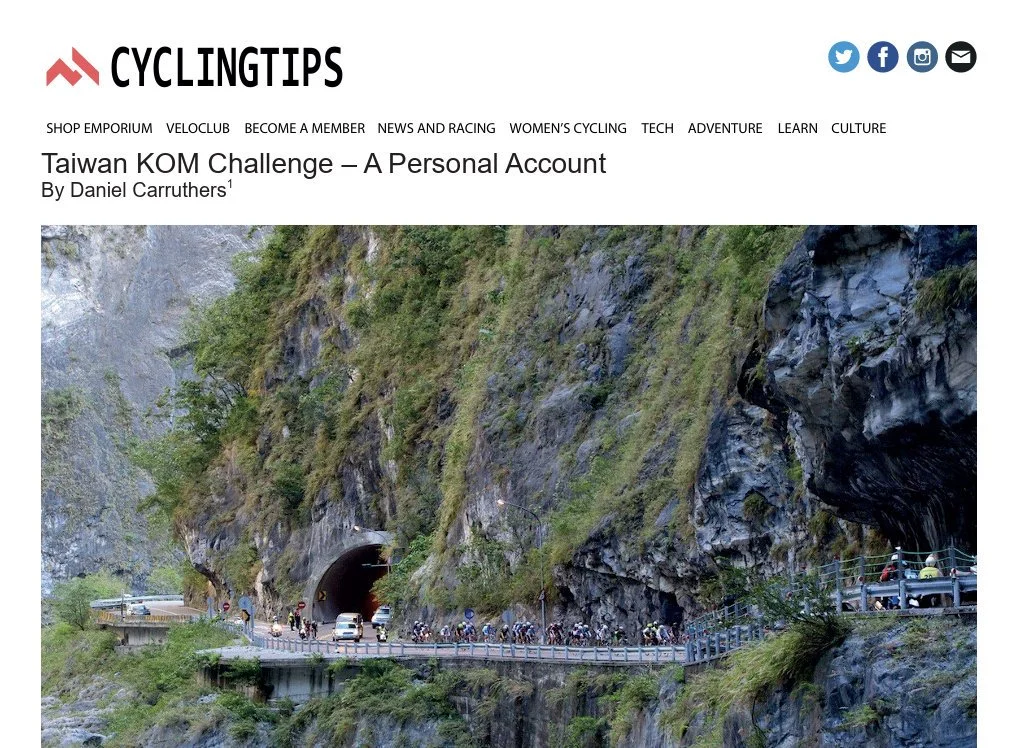
This personal recount, published as a feature article in CyclingTips, persuades keen and endurance-focused cyclists to participate in the Taiwan KOM Challenge by presenting it as prestigious, extremely difficult, visually breathtaking, and ultimately rewarding. The writer first establishes its elite status through imperative language and the authority of the publication. He then emphasises its severity through statistics, hyperbole, and powerful photographic evidence. Next, he highlights its spectacular beauty through vivid imagery and striking visuals. Finally, he presents personal triumph and social proof to frame the challenge as a defining and admired achievement within the cycling community.
First, the writer establishes the prestige and significance of the Taiwan KOM Challenge, framing it as an iconic and aspirational event within the cycling world. Through imperative language such as “should be on every cyclist’s bucket list,” he creates a sense of obligation and aspiration, positioning participation as a defining milestone rather than a casual choice. This appeal is strengthened by the prominent headline “Taiwan KOM Challenge – A Personal Account” displayed at the top of the professionally branded CyclingTips webpage, along with the visible navigation bar, such as “News and Racing,” “Adventure”, and social media icons, which visually situate the article within a respected, specialist cycling publication. This appeal to credibility, reinforced through professional layout and branding as graphic evidence of authority, strengthens the event’s legitimacy and prestige within elite cycling culture, which is persuasive because readers are more likely to value and aspire to an event endorsed by a credible and authoritative platform.
Next, he highlights the extreme difficulty of the climb, using statistics such as a 3,500m ascent and gradients of up to 27% to construct a logos-based appeal. These measurable details authenticate the challenge and appeal to performance-driven cyclists. The severity is reinforced through the large embedded photograph showing cyclists riding along a narrow road carved into a sheer cliff face, as well as the dark tunnel entrance and steep rock walls towering above them. The visual scale and contrast of the near-vertical cliffs and the exposed roadway serve as graphic evidence of danger and intensity, concretising the textual references to “impossible gradients” and “70km of solid climbing,” which employ hyperbole and loaded language. This combination of statistical evidence and emotive diction is persuasive because it makes the challenge appear legitimately formidable and therefore more appealing to ambitious cyclists seeking a true test of endurance.
He then develops the climb’s visual and experiential appeal, employing superlative language such as “one of the most stunningly beautiful roads to cycle over.” This claim is visually substantiated by the image of Taroko Gorge, with lush greenery clinging to dramatic rock faces and a winding road suspended above a deep drop. The use of scale and contrast, with cyclists appearing small against the immense cliffs, reinforces the grandeur described in the text. This integration of vivid imagery and graphic evidence makes the beauty tangible, transforming the climb into a breathtaking spectacle rather than merely a physical challenge, which is persuasive because it appeals to readers’ sense of adventure and desire for extraordinary, memorable experiences.
Finally, the narrative culminates in personal perseverance and triumph, reframing suffering as meaningful accomplishment. The progression from struggle to a final sprint demonstrates a triumphant resolution structure, reinforcing the rewards of endurance. This is visually reinforced by the image of a group of cyclists actively ascending together along the cliffside road, symbolising resilience and collective determination. His claim that “every keen cyclist” becomes excited about the KOM operates as social proof and a bandwagon appeal, while the racing context implied by the organised group of riders and shared roadway further situates the event within a serious sporting environment. Together, these rhetorical and visual strategies construct the Taiwan KOM Challenge as a prestigious, demanding, and ultimately defining experience, which is persuasive because it encourages readers to associate participation with pride, belonging, and personal accomplishment.
Overall, through vivid imagery supported by photographic evidence, authoritative publication context, factual data about difficulty, and appeals to community admiration, the article persuasively constructs the Taiwan KOM Challenge as a beautiful, prestigious, and transformative experience worth pursuing. However, the depiction of danger, including references to landslides, narrow roads with “a gaping drop,” and a car nearly clipping the rider, may also discourage more risk‑averse cyclists. For these readers, the event may appear not only physically overwhelming but also unsafe.