IB English Paper 1 — Comic Strip (SPEC 2021)
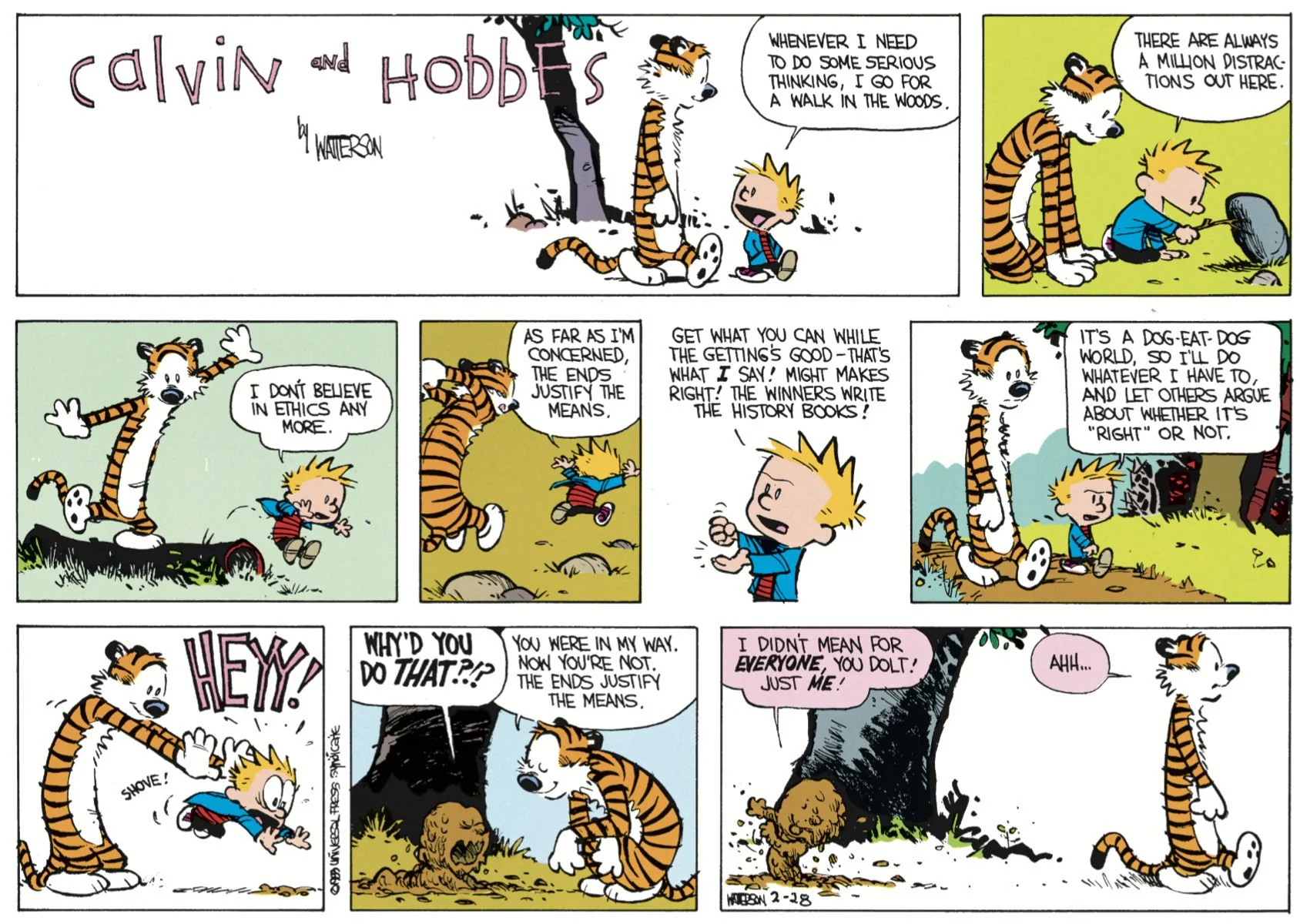
In modern society, where success and competition are often valued over fairness and shared responsibility, young readers seek guidance on how to understand right and wrong in a confusing world. The provided text, a 1989 comic strip titled “Calvin and Hobbes” written by Bill Watterson, aims to persuade a general newspaper audience, particularly young readers, to question selfish moral thinking and reflect on the importance of fairness. The comic strip employs a multifaceted approach. By interplaying irony with step-by-step panel sequencing as well as exaggerated character expression, the text successfully draws the reader in and encourages them to reconsider the belief that “the ends justify the means.”
The strip first shows how someone can sound smart but still lack real understanding. Calvin casually says in a rounded speech balloon, “I don’t believe in ethics any more,” using big, serious words like “ethics” and “ends justify the means,” which make him sound confident and intelligent through elevated diction. However, this formal language appears in the same panel as the image of a small, lively child walking through the woods. The contrast between his serious language and childish appearance creates verbal irony and visual contrast, weakening Calvin’s authority. While the words in the speech balloon try to make him seem mature, his exaggerated cartoon body and dramatic pose rely on character exaggeration to make him seem young and impulsive. This clear difference between what he says and how he looks encourages readers to question whether sounding confident really means being wise. By showing this gap through ironic contrast and careful panel composition, Watterson encourages readers to think critically about bold moral claims instead of simply accepting them.
As Calvin continues explaining his ideas, the strip shows how selfish thinking can sound tempting. His statements, “Get what you can while the getting’s good” and “The winners write the history books”, appear as short, catchy lines inside speech bubbles, functioning as persuasive aphorisms. These lines are general and rhythmic, using generalization and confident tone to seem convincing. However, their certainty is weakened by Calvin’s exaggerated movements and dramatic poses, created through visual exaggeration. His wide stance and big arm gestures fill the panel space, visually showing his overconfidence. The strong wording in his speech reveals hyperbole, while the lively drawings reinforce its emotional intensity. Through overstatement and exaggerated illustration, Watterson clearly reveals Calvin’s flawed reasoning, satisfying the reader’s’ need to see fairness and consequences.
The story then shows how selfish ideas fall apart when applied to everyone. After Calvin insists that “the ends justify the means,” Hobbes suddenly shoves him aside in a new panel filled with movement. This moment creates situational irony, as Calvin’s own belief is used against him. The bold, capitalized onomatopoeic “HEY!”, standing out in the frame and breaking the calm rhythm of earlier panels. The shove is emphasized through dynamic action and clear shifts in body position, turning dialogue into visible proof. When Hobbes calmly repeats Calvin’s own words in his speech balloon, it creates echoic irony, because the same phrase now exposes its flaw. The clear visual contrast between Hobbes standing steady and Calvin lying on the ground strengthens the reversal. By arranging the panels to show action and consequence at the same time, Watterson makes the argument fall apart right before the reader’s eyes, which makes his point more convincing because readers can clearly see the results for themselves.
In the final panel, which acts as the strip’s punchline, the comic clearly reveals the selfish core of Calvin’s thinking. His complaint, “I didn’t mean for everyone, you dolt! Just me.”, appears in a speech bubble above his small, dirt-covered figure. Readers feel dramatic irony because they already understand the problem before Calvin admits it. His shift from a big, general claim to a personal exception shows self-contradiction and weakens his earlier confidence. Visually, Calvin is placed lower in the frame, using visual symbolism to show his loss of power and control. His sudden, smaller confession is anticlimactic, breaking down the grand ideas he proudly announced before. The mix of his lowered posture, final speech bubble, and strong final-panel emphasis completes his downfall. This clear ending reinforces the message that selfish moral systems cannot work for everyone. By showing Calvin’s contradiction clearly in both the image and his words, Watterson makes readers see his logic fail for themselves, which makes the message more convincing because they witness the flaw instead of just being told about it.
The overall structure of the strip strengthens its criticism of selfish thinking. The dialogue moves from claim, to explanation, to action, to confession, creating a clear structural progression that matches the movement across the panels. The smooth gutter transitions guide readers step by step from cause to effect. The pacing of the speech bubbles controls emphasis, and placing the punchline in the final panel creates a strong structural payoff. Humour builds through steady irony, increasing hyperbole, expressive character exaggeration, and the rhythm created by the panel sequence. By blending sharp dialogue with deliberate panel sequencing, Watterson turns the strip’s structure into a rhetorical device that leads readers directly to the collapse of the argument.
Overall, Watterson effectively exposes selfish moral reasoning as unstable and hypocritical by illustrating the broader issue of self-centered thinking and its logical collapse. The strip allows readers to watch this flawed philosophy unravel step by step, revealing the consequences of prioritising personal gain over fairness. However, because the strip simplifies the ethical debate through exaggeration and caricature, young readers may miss the deeper complexity of the issue that moral dilemmas are often more nuanced and context-dependent than the strip suggests.