How to Write a Level 7 IB Paragraph (Paper 1)
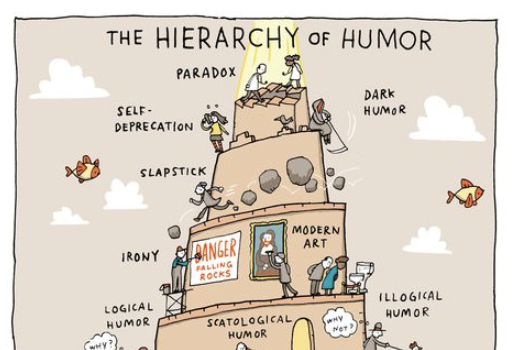
Click here to view the infographic comic.
Hey everyone, today I’m going to show you how to write a Level 7 IB English Paper 1 paragraph, using The Hierarchy of Humor by Grant Snider as an example, which you can find on his website, Incidental Comics. The essay for this paper is at the end of this blog.
What a Level 7 Paragraph Really Does
First, remember this:
A Level 7 paragraph is not just about spotting a device.
It’s about explaining why the writer chose it and how it persuades the reader.
What a Level 7 Paragraph Really Does
Here’s the four‑step formula you should always follow.
Step one: Identify the device clearly.
For example, you might say: “The ‘modern art’ section supports the text’s purpose through satire and symbolism.” This shows the examiner you know what technique is being used.
Step two: Explain how the device works in the text.
You then describe what you can actually see: “The warning sign suggests that modern art is confusing or hard to understand.” This proves you understand the text, not just the terminology.
Step three: Evaluate why the author chose this device.
This is where Level 7 starts. You ask why, not just what: “By exaggerating this idea, Snider mocks the belief that difficulty equals intelligence.” Now you’re showing authorial choice and intention.
Step four: Explain how this choice shapes meaning and persuades the reader.
This is the most important part: “This persuades readers to question how society decides what is considered ‘high quality’ culture.” Here, you clearly connect the device to the reader’s response and the text’s purpose.
Quick Level 7 Checklist
So, to recap:
device
how it works
why the author chose it
how it persuades the reader
Final Advice
If your paragraph does all four, you are writing at Level 7.
And remember, clarity is better than sounding complicated.
If the examiner can clearly follow your thinking, you’re already ahead.
Exemplar Essay
The following illustrated infographic, The Hierarchy of Humor, is created by cartoonist Grant Snider, whose work is published through his platform Incidental Comics and in outlets such as The New Yorker and The New York Times.
- How does the text use humor to convey its purpose?
Grant Snider’s illustrated infographic The Hierarchy of Humor uses humor to challenge the idea that some types of comedy are more valuable than others. By using satire and visual jokes, the text encourages readers to question the way humor is often ranked as “high” or “low.” Through exaggeration, irony, and playful visuals, Snider uses humor to persuade readers that all comedy has value because it brings people enjoyment. By laughing at the hierarchy, readers may realize that they also judge humor in the same way the cartoon is making fun of.
The tower structure helps convey the text’s purpose by humorously exaggerating the idea of ranking humor. Snider uses a visual metaphor by turning humor into a tall, unstable building, representing how people try to organize comedy in a serious and logical way. This exaggeration makes the system appear fragile and unrealistic rather than authoritative. By choosing a visual metaphor instead of a written explanation, Snider allows readers to grasp the critique instantly, without needing complex analysis. This choice is persuasive because the humor lowers resistance, encouraging readers to laugh at the hierarchy before recognizing how artificial and unreliable such rankings truly are.
The placement of “dumb jokes” and “cats” at the bottom of the tower supports the text’s purpose by using contrast to challenge ideas about value. Although these types of humor are often seen as low quality, they are shown as the most crowded and active areas. Snider deliberately uses visual density to show popularity and enjoyment, suggesting that the humor many people enjoy is socially meaningful. This choice persuades readers by highlighting the gap between what is popular and what is respected, encouraging them to question why intellectual humor is valued more than shared happiness.
The section showing puns as locked doors supports the text’s purpose through visual wordplay. The doors that require keys suggest that puns need special knowledge to understand them. This device highlights how some humor can be exclusive and difficult to access. By presenting this idea as a joke rather than a direct criticism, Snider avoids sounding judgmental, which makes readers more open to the message. As a result of this gentle satire, readers are persuaded to reconsider whether humor that excludes others should really be seen as superior.
The placement of “logical humor” and “illogical humor” on the same level helps convey the purpose by using irony and contradiction. These two ideas are opposites, yet they are ranked equally, which makes the system seem illogical. Snider uses this contradiction to let the hierarchy collapse on its own, rather than telling the reader it is flawed. This choice is persuasive because readers discover the problem themselves, making the critique feel more convincing and thoughtful.
The “modern art” section supports the text’s purpose through satire and symbolism. The warning sign suggests that modern art is confusing or hard to understand, reflecting common cultural opinions. By exaggerating this idea, Snider mocks the belief that difficulty equals intelligence, exposing how cultural value is often based on confusion rather than meaning. Through satirical exaggeration, Snider persuades readers to question how society decides what is considered “high quality” culture.
Slapstick humor supports the text’s purpose through self‑referential humor. Characters are shown falling or being hit by rocks inside the diagram itself, meaning the humor happens within the hierarchy. This choice is effective because it shows humor breaking the very structure meant to control it, reinforcing the idea that humor cannot be contained by rules. This visual disruption persuades readers that ranking humor is unrealistic because humor exists naturally and everywhere.
Finally, placing “paradox” at the top of the tower supports the text’s purpose through structural irony. Paradoxes do not have clear answers, so placing them at the highest level causes the system to fall apart. Ending the hierarchy this way is effective because it leaves the reader without a clear conclusion, mirroring the idea that humor cannot be fully explained or ranked. This structural uncertainty persuades readers that searching for the “highest” form of humor is meaningless.
In conclusion, The Hierarchy of Humor uses humor to effectively communicate its purpose of challenging how comedy is ranked. Through visual metaphors, irony, and exaggeration, Snider shows that humor cannot be fairly judged by intelligence. By making readers laugh at the hierarchy, the text encourages them to rethink their own beliefs and recognize that humor’s true value lies in enjoyment and connection.