High-Scoring IB Paper 2 Essay
IBDP English A Paper 2 Essay
- How do two works you’ve studied explore the theme of family?
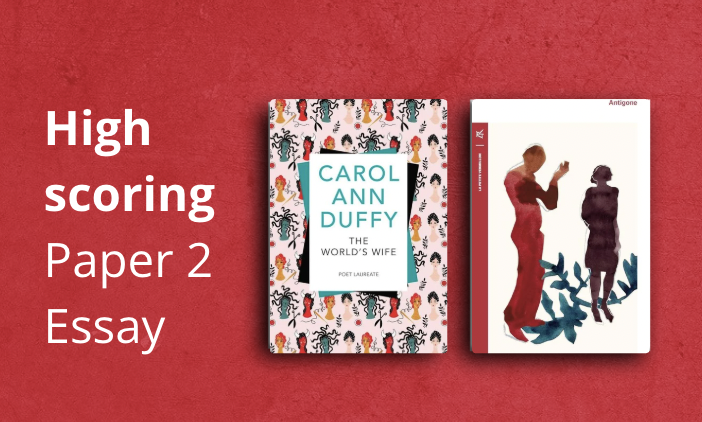
Family in literature is often shown as a source of love and support, but it can also be a place of control, conflict, and resistance. In Jean Anouilh’s Antigone and Carol Ann Duffy’s poems “Little Red-Cap”, “Mrs Lazarus”, and “Queen Herod,” family is not stable or comforting; instead, it becomes a site of conflict, control, and resistance. Anouilh presents family as a tragic space of conflict, where unwavering sibling loyalty brings Antigone into fatal opposition with the authority of the state. In contrast, Duffy exposes the ways family structures function as mechanisms of control, particularly within patriarchal roles such as daughter, wife, and mother. While both writers interrogate the pressures family places upon the individual, Anouilh emphasises the tragic consequences of absolute loyalty, whereas Duffy critiques and destabilises the systems of control embedded within familial expectations..
In both Antigone and Little Red-Cap, family acts as an inherited system of authority that function as a form of control, wherein the young female protagonist must either obey or reject it. In Antigone, this conflict first appears in Antigone’s debate with Ismene, where she insists that Creon will do what he must and they in turn must do what they have to do. The mirrored phrasing and repetition create syntactic balance, presenting duty as structurally inevitable rather than emotionally chosen. Antigone’s language relies on modal certainty and declarative statements, while Ismene’s speech is filled with fear and conditional reasoning, creating a rhetorical contrast between absolutism and hesitation. When Antigone rejects the idea of “sort of seeing” the situation, her dismissal of ambiguity becomes a rejection of compromise itself. Anouilh’s sparse dialogue and lack of elaborate stage movement focus attention on verbal confrontation, allowing language to function as action. The scene dramatizes how loyalty to family operates as a rigid moral code that overrides relational harmony, fracturing the sisterly bond before the political conflict even begins. In contrast, Little Red-Cap begins with “At childhood’s end,” a phrase that signals growth and independence. While Antigone’s language narrows toward moral rigidity, Red-Cap’s voice expands through the forest imagery, which symbolises experience and creative awakening. The Wolf represents patriarchal literary authority, yet Duffy uses the violent, active verb in “I took an axe to the wolf” to assert agency. By the end, she leaves “with my flowers, singing, all alone,” a final image of self-directed autonomy. While Anouilh presents family as a fixed ethical structure expressed through rigid syntax and repetition, Duffy presents it as a system that can be dismantled and rewritten.
Family becomes a site of conflict when loyalty is tested through sibling and marital bonds in Antigone and “Mrs Lazarus.” Competing ideas of duty, attachment, and moral responsibility destabilise relationships, transforming private devotion into ideological and emotional struggle. In the central confrontation with Creon, Antigone’s rhetoric becomes explicitly theological and uncompromising. When she argues that the unburied wander without rest, she invokes divine consequence, shifting the debate from civic law to sacred order. Anouilh stages this scene as an extended dialectical exchange, allowing competing ideologies to unfold through argument rather than action. Creon’s language is pragmatic and political, as he describes ruling as a “trade,” insists he must “roll up [his] sleeves,” and compares the state to a storm-tossed ship whose captain must seize the wheel to impose order. By contrast, Antigone speaks in absolute moral terms, claiming she “owed it” to her brother and that the unburied “wander eternally,” grounding her defiance in sacred duty rather than civic stability. When she ultimately declares that if life cannot remain pure she chooses death, the abrupt declarative structure strips the moment of sentimentality and transforms it into existential defiance. The scene’s tension derives from rhetorical escalation rather than physical violence, emphasizing that tragedy here is born of language and belief. In Mrs Lazarus, however, marital loyalty changes over time. The speaker begins with intense grief: “I had grieved. I had wept for a night and a day,” the anaphoric repetition suggesting ritualised mourning. As time passes, her husband becomes “legend, language;” reduced through abstract nouns to narrative rather than presence. When he returns as “my bridegroom in his rotting shroud,” the grotesque imagery destabilises the romantic ideal. Whereas Antigone’s loyalty is constructed through rigid moral rhetoric that refuses temporal change, Duffy structures loyalty as something eroded and reshaped by time. Anouilh presents devotion as ideologically absolute; Duffy presents it as psychologically mutable.
Family is also directly linked to resistance that manifests in violence in Antigone and Queen Herod, as acts meant to protect loved ones lead to destruction. In the later scenes of Antigone, Anouilh shifts from debate to consequence, and familial conflict expands into public catastrophe. Haemon’s confrontation with Creon introduces generational opposition, and his warning that the people still honour the gods Creon dismisses signals the widening political impact of private defiance. Creon’s insistence that the law must be obeyed reflects his rigid adherence to civic authority, and the declarative force of this claim mirrors Antigone’s earlier absolutism, structurally aligning father and rebel in their inflexibility. The Messenger’s narrative report of Haemon’s suicide, dying beside Antigone in a “great pool of blood”, uses vivid imagery to convert ideological conflict into physical devastation. Eurydice’s silent suicide, reported rather than staged, reinforces the play’s use of offstage death to heighten tragic inevitability and emotional restraint. Through this structural distancing, Anouilh emphasises that family loyalty, once absolutised, becomes self-perpetuating destruction. In Queen Herod, Duffy also links family and violence, but through satire rather than tragic inevitability. The prophecy to “Watch… for a star in the east” functions symbolically, while the listing of male archetypes, “The Husband. Hero. Hunk.”, fragments masculine identity into predictable roles. Herod’s vow that no man will make her daughter cry frames motherhood as militant resistance, and her command to “kill each mother’s son” mirrors Antigone’s extremity, though expressed through parody and exaggeration. In both works, love for family generates bloodshed; however, Anouilh constructs violence through escalating dramatic structure and tragic irony, while Duffy employs satire and rhetorical listing to critique patriarchal cycles. Through contrasting techniques, both writers reveal how devotion can justify destruction.
Ultimately, both Anouilh and Duffy show that family is not simply a place of comfort but a powerful force that shapes identity and power. In Antigone, family loyalty demands total commitment, even when it leads to death and widespread tragedy. In Duffy’s poems, the roles of daughter, wife, and mother are questioned and reshaped, allowing women to redefine the limits of loyalty. Anouilh suggests that family duty is dignified yet fatal, while Duffy suggests that family systems can be challenged and rewritten. Together, these works show that family is neither entirely protective nor entirely oppressive. Instead, it is a powerful structure that shapes how individuals struggle for independence and self-definition.