
Your conclusion should answer: How effective is the text, and what are the limits of its approach? Rather than repeating each body paragraph, bring your analysis together into a final judgement.
1. Explain its effectiveness
Identify the text’s strongest feature and explain why it works for the intended audience. Connect it to the writer’s purpose—not just to “getting attention.”
For example:
The ad’s interactive pregnancy test makes the promotion personally relevant to expectant parents, helping IKEA appear supportive at an important moment in their lives.
2. Consider its limitations
A limitation is not simply something you dislike. It is a weakness or tension in how the text communicates its message. Consider whether it excludes certain readers, simplifies a complex experience or uses emotion to influence decisions.
For example:
However, linking pregnancy to buying furniture shows how advertising can turn a personal milestone into a consumer need.
This evaluates the ad’s use of media power rather than simply calling it ineffective.
3. Finish with a balanced judgement
Explain what this tension means for the text as a whole. Avoid claiming that every reader will respond in the same way.
A useful structure is:
Overall, [strongest feature] effectively helps the text [achieve its purpose] by [audience effect]. However, [limitation] reveals [broader implication].
Keep the conclusion brief, use ideas already developed in your essay and leave the reader with a clear judgement—not a list of techniques.
Practice Paper & Essay Response
Click here to see the original advertisement at the D&AD Awards Archive.
Guiding Question: How do visuals, language, and structure help to convey the text’s purpose?
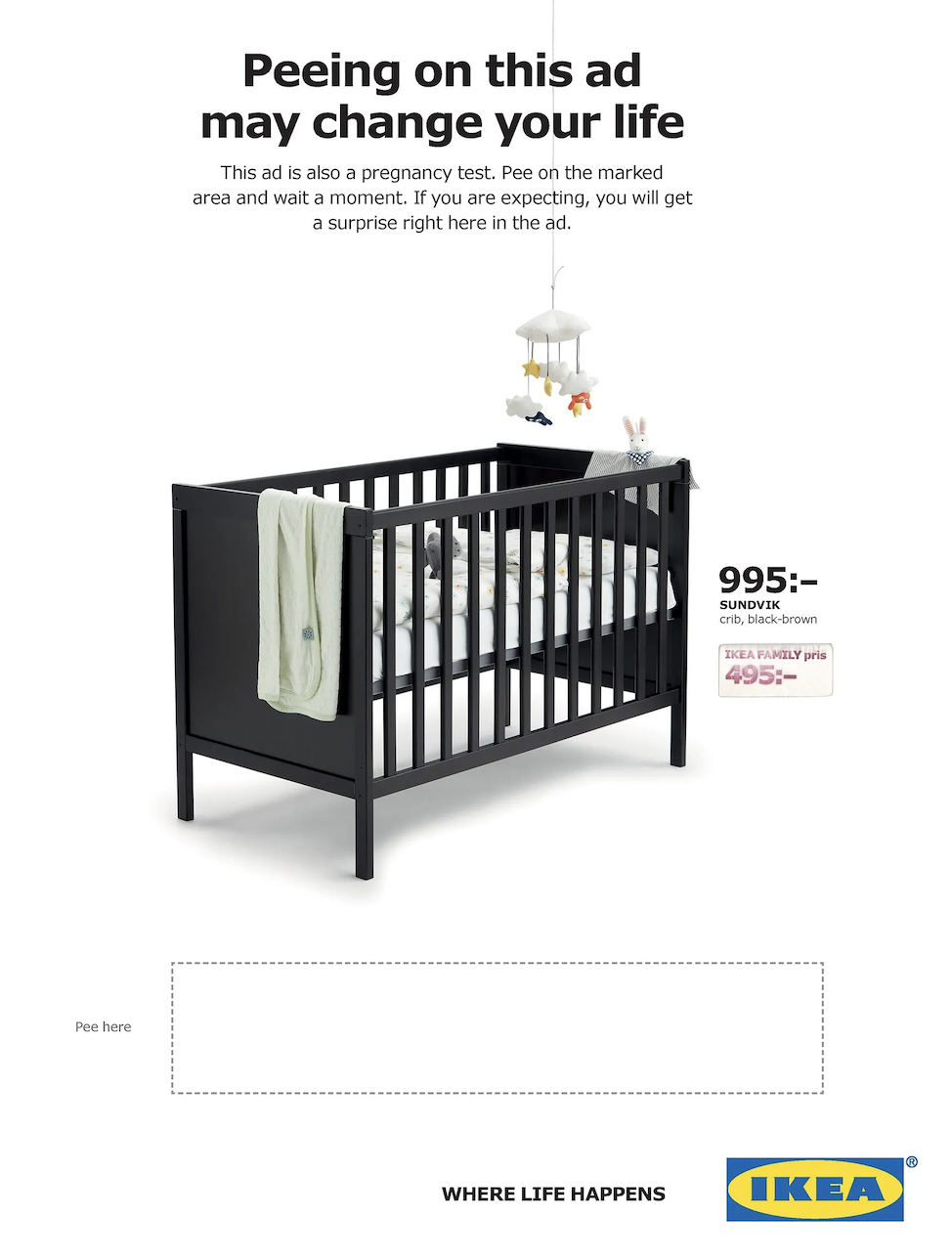
In modern society, where preparing for a baby can be exciting but financially stressful, expectant parents look for affordable products they can trust. IKEA’s 2018 print advertisement, “Peeing on this ad may change your life,” created by Åkestam Holst and published in the Swedish magazine Amelia, encourages these parents to purchase its SUNDVIK crib. Through its surprising, conversational language, simple imagery of a furnished crib, and layout that leads readers from the bold headline to the pregnancy-testing area, the ad connects the personal experience of discovering a pregnancy with buying furniture. This presents IKEA as a brand that understands growing families, while also using an emotional moment to promote its products.
The advertisement’s visuals present the crib as both practical and comforting, appealing to parents who want to prepare a welcoming space for their baby. The large central product image uses visual salience, drawing the reader’s attention to the crib before its smaller details. This makes the product immediately noticeable and encourages readers to imagine it in their own homes. Within the image, colour contrast between the dark frame and pale bedding creates a balance between sturdiness and softness. This is persuasive because it suggests both reliability and comfort, although appearance alone cannot establish the crib’s safety or quality. The blanket and hanging mobile introduce domestic imagery, turning the furniture display into a scene associated with caring for a newborn. These familiar objects encourage an emotional connection by suggesting the family life readers may be anticipating. Meanwhile, the surrounding white space isolates the product and keeps the page uncluttered, making the choice appear straightforward at a potentially overwhelming time. This calm visual presentation also sets up a striking contrast with the advertisement’s deliberately provocative language.
Against this reassuring background, the headline “Peeing on this ad may change your life” captures attention through colloquial diction. The blunt word “peeing” breaks with the polished language expected in advertising, making the message conversational and memorable, though it risks alienating readers who find it inappropriate. The phrase “may change your life” adds double meaning, referring both to discovering a pregnancy and to the surprise offered by the advertisement. This gives the headline emotional significance beyond its initial humour, while connecting a major personal event to a commercial promotion. The direct address in “your life” and “If you are expecting” makes the reader personally involved rather than a distant observer. This is particularly effective for the intended audience because the message speaks directly to their possible circumstances. Once that interest is established, the imperative verbs in “Pee on the marked area and wait a moment” give clear instructions, making an unusual interaction seem manageable. Finally, “WHERE LIFE HAPPENS” uses emotive language to associate IKEA with meaningful everyday experiences. This supports the brand’s caring image, but also shows how the advertisement turns the emotions surrounding parenthood into an incentive to consider its products—a movement developed further through the layout.
The advertisement’s structure guides readers through this movement, from curiosity to product consideration and participation. Its typographic hierarchy, created by the large, bold headline above the smaller explanatory text, prioritises the surprising statement before providing practical information. This makes the advertisement easy to follow while ensuring that its attention-grabbing claim is not lost among the details. The explanation “This ad is also a pregnancy test” then uses delayed revelation to resolve the puzzle introduced by the headline. By briefly withholding this information, the ad gives readers a reason to continue reading. The central placement of the crib connects that revelation to a product expectant parents may need, making the promotion relevant while subtly steering a personal discovery towards a purchase. Beside the crib, the price “995:-” uses spatial juxtaposition, allowing readers to assess the product and its cost together. This foregrounds price as a selling point, although the figure alone does not prove affordability. Below the product, the outlined testing area and “Pee here” instruction form an interactive call to action, inviting readers to participate rather than simply observe. This makes the advertisement personally engaging, although its success depends on readers’ willingness to use the test. The closing placement of the IKEA logo and slogan finally links the experience back to the brand, helping ensure that readers remember not only the unusual idea but also the retailer behind it.
Overall, the ad’s most effective feature is its built-in pregnancy test, which turns an ordinary furniture promotion into a personal and memorable experience. Its surprising headline, comforting image of the crib and clear layout connect IKEA with the excitement of preparing for a baby. However, this connection also reveals the power of advertising to shape how people understand important life events. By placing a product at the centre of discovering a pregnancy, the ad suggests that buying furniture is a natural next step towards becoming a prepared, caring parent. Its limitation is therefore that, while it presents IKEA as supportive, it reduces a complex personal experience to a consumer need, showing how easily media can blur the line between offering help and encouraging consumption.