3 Ways to Structure Your Paper 1 Essay
You’ve identified the writer’s purpose and spotted some interesting choices, but how should you organize your essay?
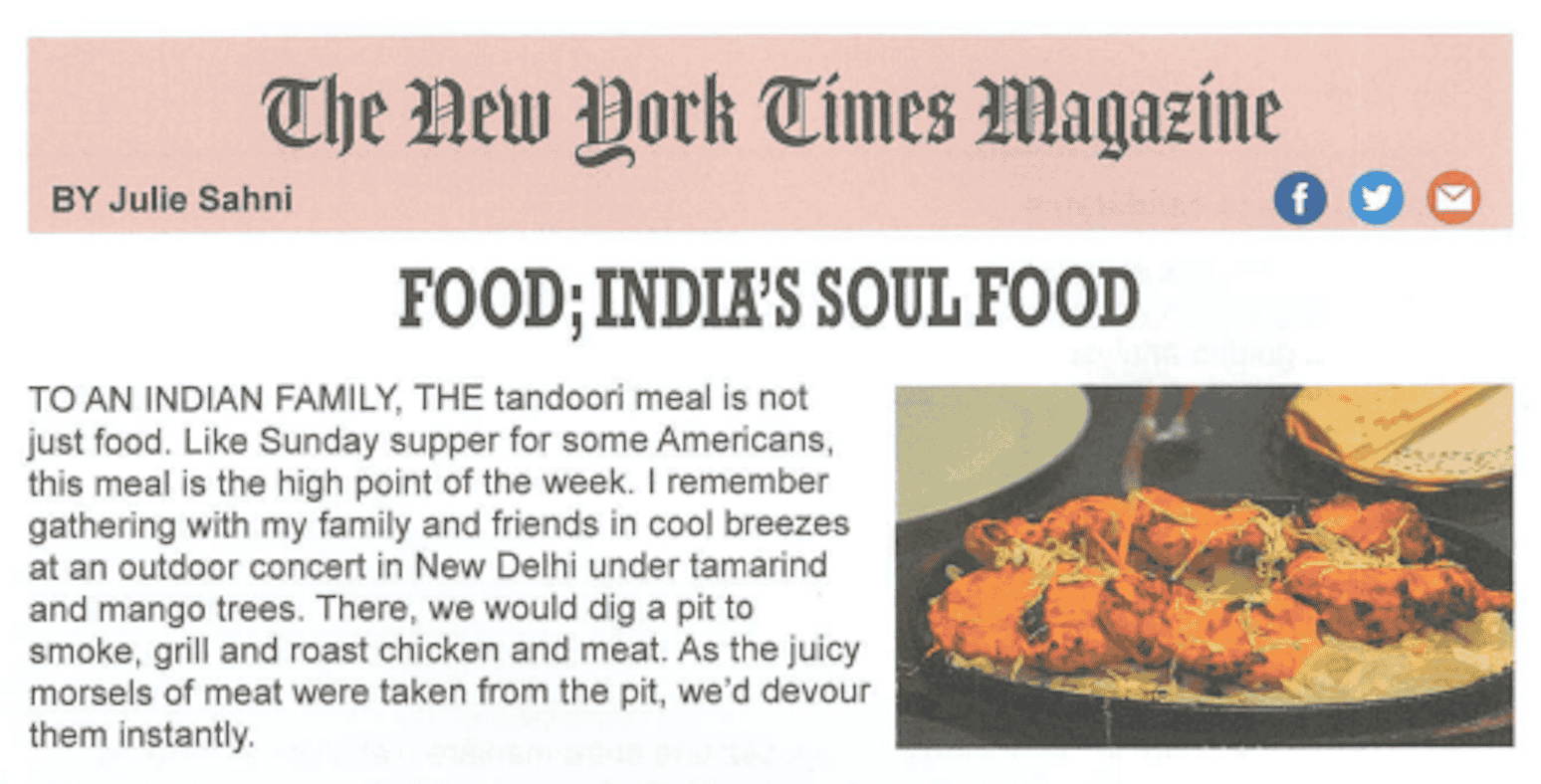
Using Julie Sahni’s “Food; India’s Soul Food” from the May 2021 Paper 1, published in The New York Times Magazine, this blog explores three approaches: section by section, following the writer’s developing arguments; by features, examining visual, language, and structural choices; and by persuasive appeals, exploring credibility and trust, emotion, and reason.
The guiding question asks:
Discuss how different features are used on this webpage to create an impression of Indian culture.
Model body paragraphs for each approach follows at the end, showing how the same text can support three different analytical structures.
Choosing the Right Structure for Your Text
Each structure offers a different route to answering the same question:
Section by section: Useful for texts with distinct sections or a clear progression of ideas.
By features: Particularly useful for visually rich texts, where images, layout, and language work together.
By persuasive appeals: Particularly useful for prose-heavy texts that build credibility, engage emotions, and appeal to reason.
Let the Guiding Question Lead
If the guiding question’s keyword is tone, for example, each paragraph should explain how particular choices establish or shift tone. If the focus is images, each paragraph should keep images central, discussing language and layout through their relationship with those images.
Section by section: Examine how the focus develops across the text.
By features: Analyze how visual, linguistic, and structural choices contribute to that focus.
By persuasive appeals: Explore how credibility, emotion, and reason contribute to that focus—where relevant.
Keep the keyword in focus analytically, not just verbally: explain how your evidence answers the guiding question rather than merely repeating its wording. Choose the structure that makes this connection clearest; don’t force an approach that does not suit the text.
1. Section by Section Approach
This approach follows the writer’s arguments, chronologically. To do that, organize your paragraphs around the text’s headings (found in infographics, articles, brochures, etc.), main claims (found in essays, letters, memoirs, etc.), or narrative stages (found in comic strips, memoirs, anecdotal articles, etc). Instead of dividing it into arbitrary chunks, identify how its ideas develop.
For Sahni’s article, you could use:
Paragraph 1 — Family tradition and cultural origins: How the opening presents tandoori cooking as emotionally meaningful and historically interconnected.
Analyze the visual, linguistic, and structural features that support its central claim.
Evaluate how effectively these features shape readers’ views
Paragraph 2 — Popular appeal and social divisions: How the middle explores enjoyment of the food alongside changing class attitudes.
Analyze the visual, linguistic, and structural features that support its central claim.
Evaluate how effectively these features shape readers’ views
Paragraph 3 — Practicality and adaptability: How the final section makes tandoori cooking accessible to readers outside India.
Analyze the visual, linguistic, and structural features that support its central claim.
Evaluate how effectively these features shape readers’ views
The plan keeps the guiding question’s keywords at the centre of the analysis:
GQ: Discuss how different features are used on this webpage to create an impression of Indian culture.
2. Features Approach
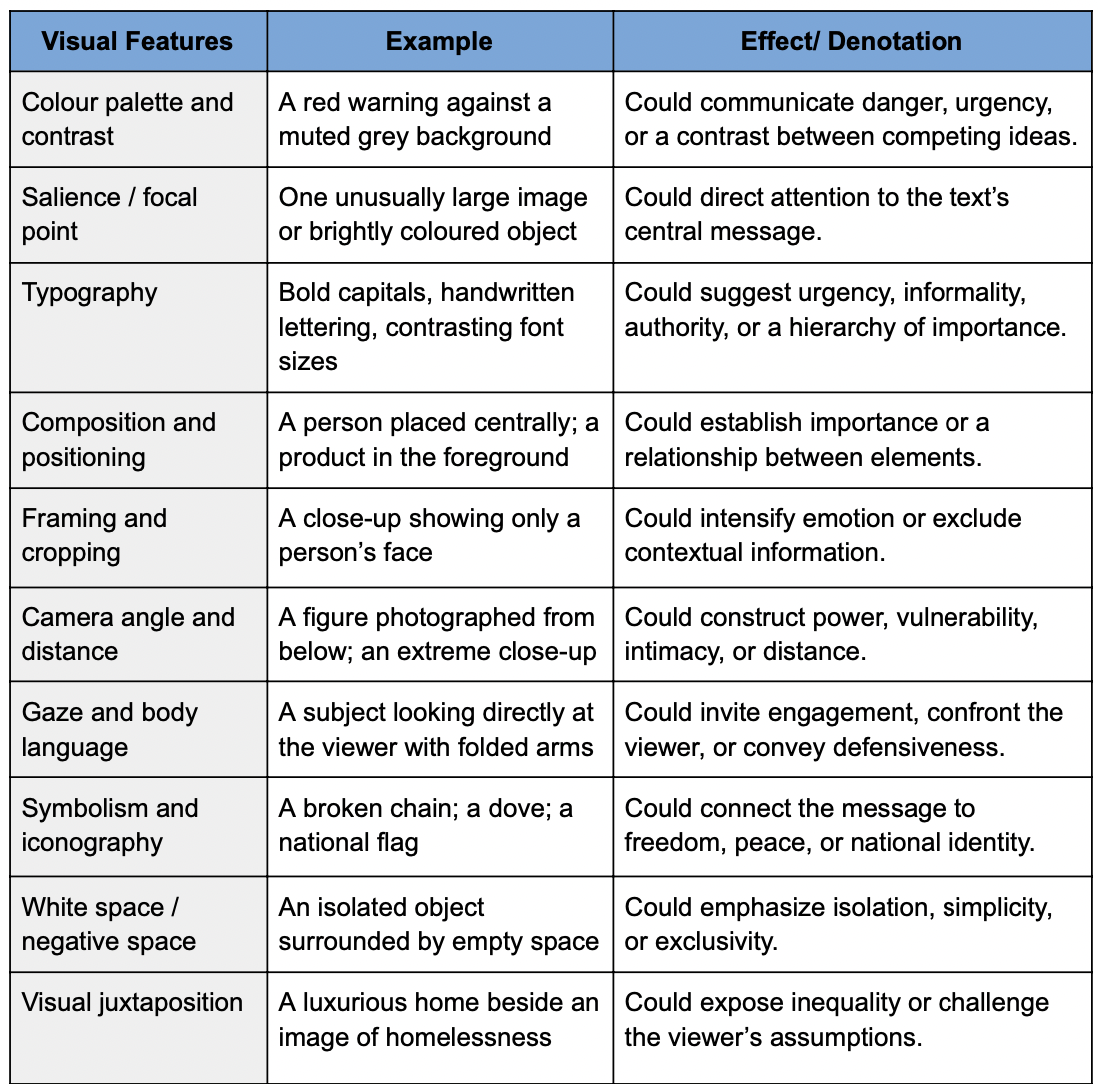
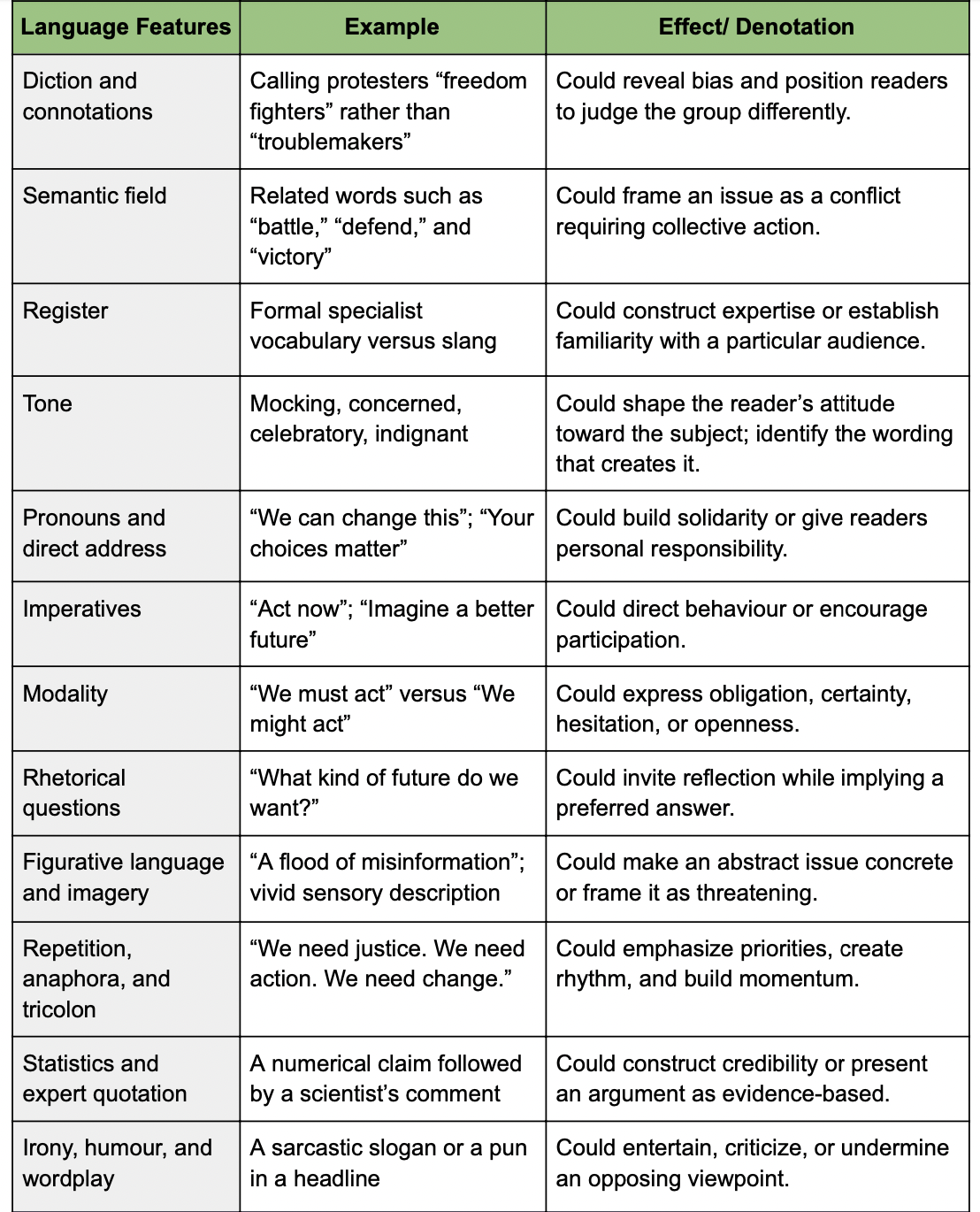
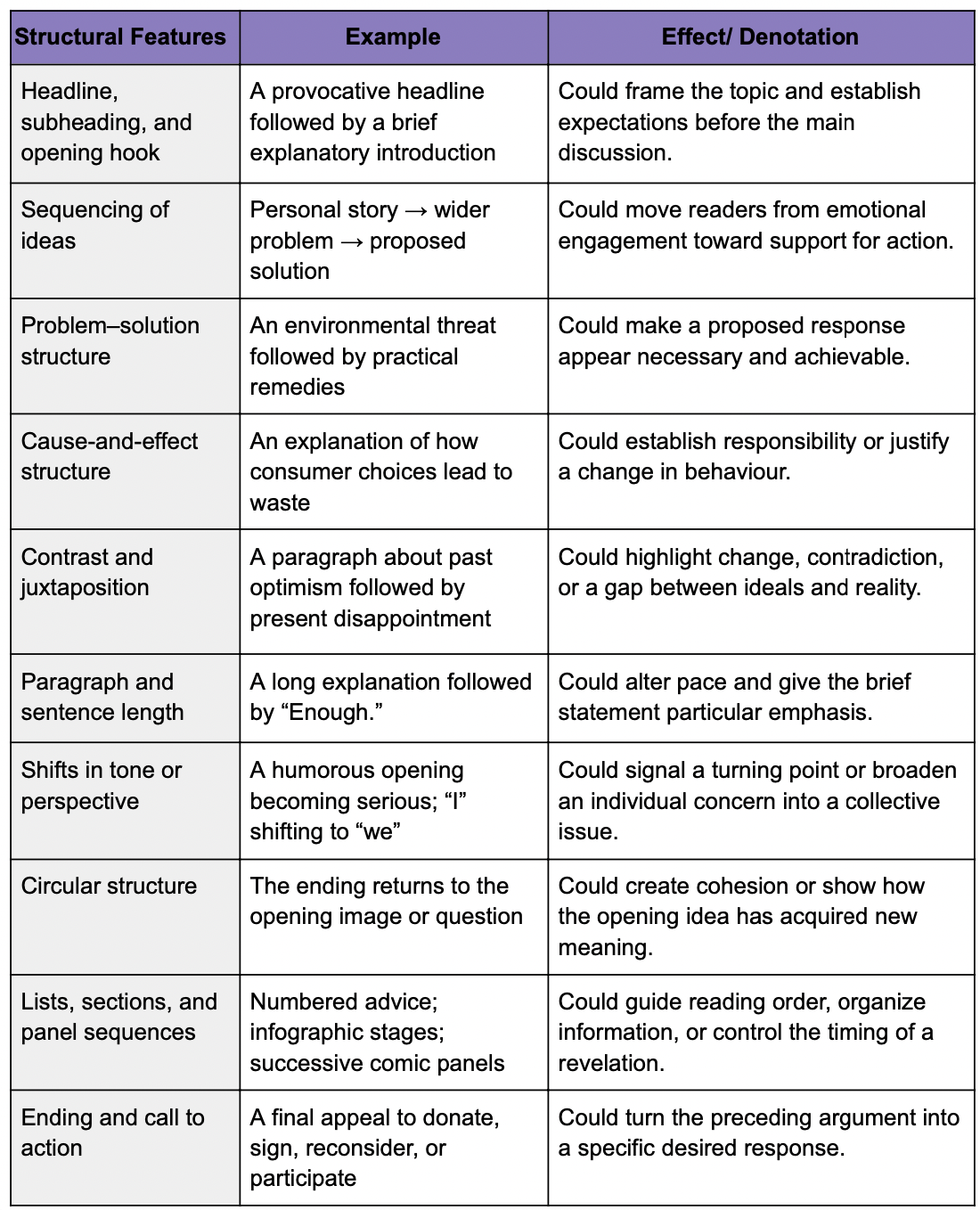
In this approach, you group your paragraphs around visual, language, and structural features.
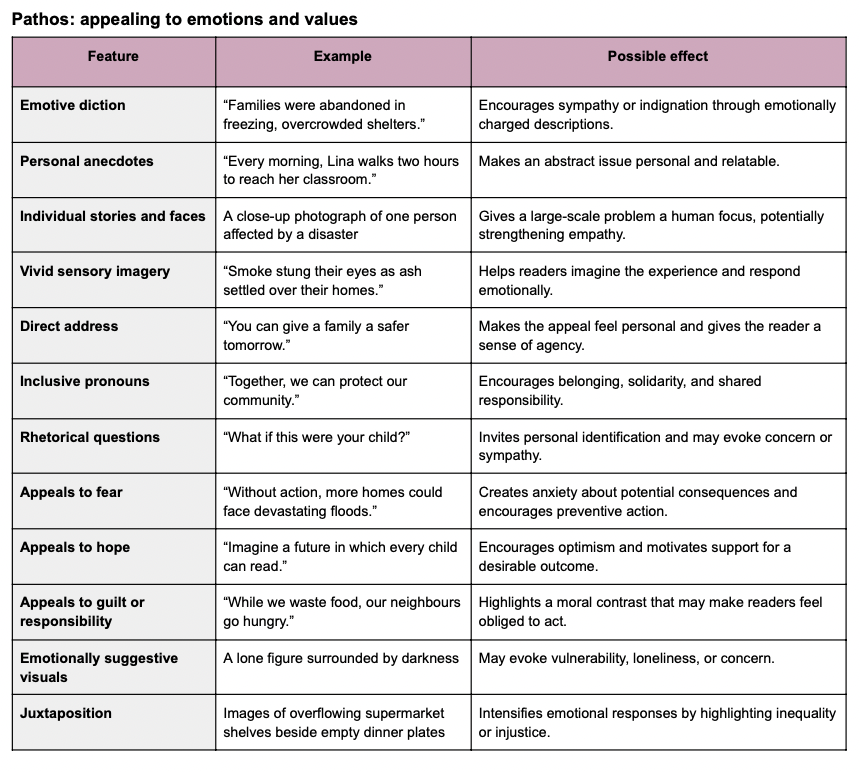
CHART 1: a chart of devices commonly used to create each feature is provided at the end of this blog.
For Sahni’s article, you could explore:
Paragraph 1 — Visual features: How the food photograph, bold headline, and magazine masthead present Indian cuisine as appealing and culturally significant.
Analyze the visual features that support its central claim.
Evaluate how effectively these features shape readers’ views
Paragraph 2 — Language features: How sensory imagery, personal recollection, and the comparison with “Sunday supper” present Indian culture as warm and relatable.
Analyze the linguistic features that support its central claim.
Evaluate how effectively these features shape readers’ views
Paragraph 3 — Structural features: How the progression from family memories to history and practical guidance presents the tradition as both rooted and adaptable.
Analyze the structural features that support its central claim.
Evaluate how effectively these features shape readers’ views
The plan keeps the guiding question’s keywords at the centre of the analysis:
GQ: Discuss how different features are used on this webpage to create an impression of Indian culture.
3. Persuasive Appeals Approach
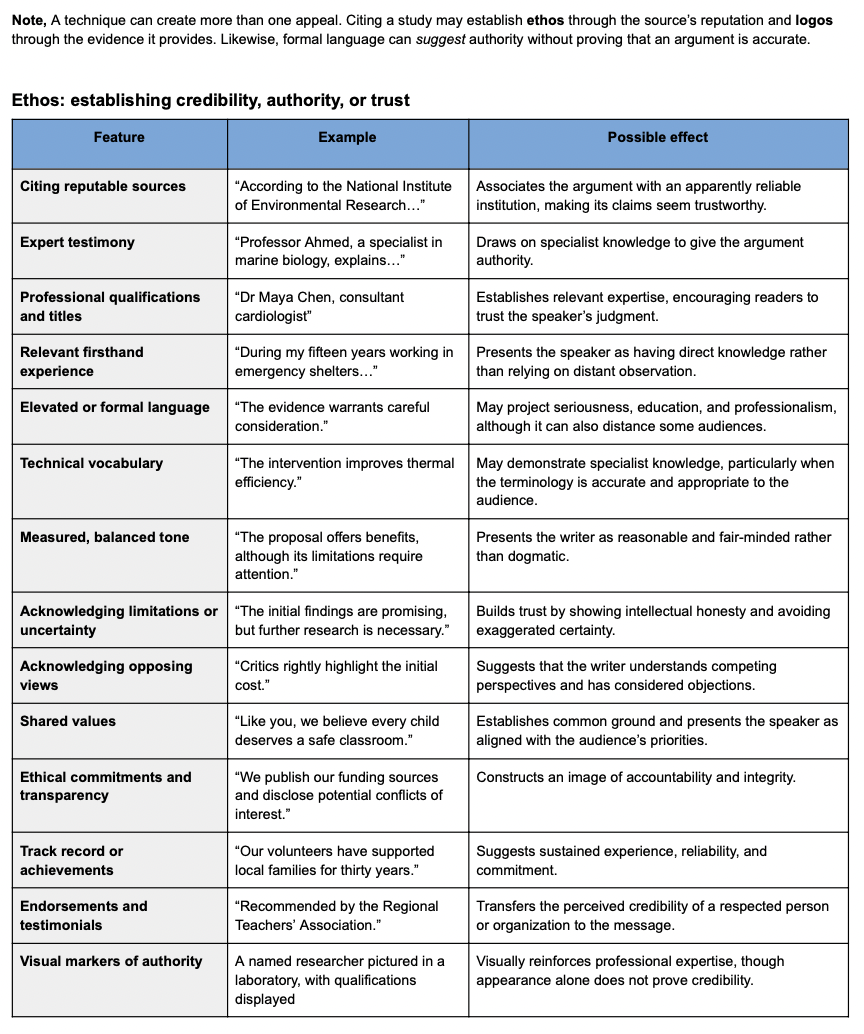
For this approach, you organize your paragraphs around Aristotle’s persuasive techniques: credibility and trust, emotion, and reason.
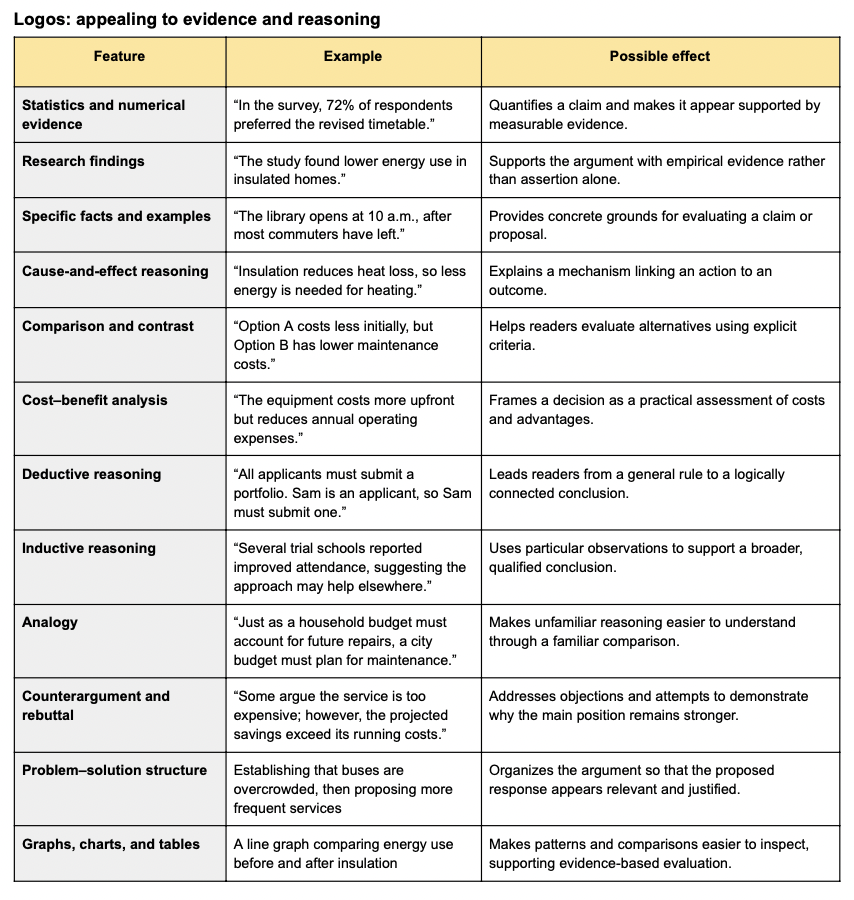
CHART 2: a chart of devices commonly used to create each appeal is provided at the end of this blog.
For Sahni’s article, this could look like:
Paragraph 1 — Credibility and trust (ethos): How firsthand experience, historical details, and publication branding establish authority.
Analyze the rhetorical features that support its central claim.
Evaluate how effectively these features shape readers’ views
Paragraph 2 — Emotion (pathos): How family memories, sensory descriptions, and food photography encourage affection and interest.
Analyze the rhetorical features that support its central claim.
Evaluate how effectively these features shape readers’ views
Paragraph 3 — Reason (logos): How explanations of cooking processes and alternatives to traditional equipment make the cuisine seem approachable.
Analyze the rhetorical features that support its central claim.
Evaluate how effectively these features shape readers’ views
The plan keeps the guiding question’s keywords at the centre of the analysis:
GQ: Discuss how different features are used on this webpage to create an impression of Indian culture.
Keep the Analytical Core
Whichever structure you choose, develop each supporting example through:
[Device & Evidence] Identify a specific choice and provide evidence.
[Explanation/Effect] Explain how it creates meaning in context.
[Evaluation/Effectiveness] Assess how effectively it serves the writer’s purpose for the intended audience.
For example:
[Device] Sahni uses a cross-cultural analogy in “Sunday supper for some Americans.” [Explanation] This connects the tandoori meal to a potentially familiar family ritual. [Evaluation] It makes Indian culture relatable to an American readership while the qualification “some” avoids treating American experience as uniform.
Ultimately, choose the structure that best supports your argument. All three can work, provided your essay consistently explains how the text creates meaning and answers the guiding question.
Section-by-Section: 3 Body Paragraphs
In the opening section, Sahni presents tandoori cooking as a cherished family tradition whose cultural significance extends beyond its geographical origins. [Device] Emphatic negation introduces the meal as “not just food.” [Explanation] This immediately distinguishes eating for nourishment from eating as a meaningful communal ritual, establishing the cultural importance of the discussion that follows. [Evaluation] Readers are encouraged to understand Indian cuisine through its role in everyday relationships rather than viewing it merely as an exotic product. [Device] A cross-cultural analogy compares the meal to “Sunday supper for some Americans.” [Explanation] The comparison translates the significance of an Indian family gathering into a potentially familiar experience for the magazine’s American readership. [Evaluation] It bridges cultural distance by emphasizing shared attachments to food and family without claiming that the traditions are identical. [Device] First-person anecdote and sensory imagery combine in Sahni’s recollection of “gathering with my family” amid “cool breezes,” followed by eating “juicy morsels.” [Explanation] Her personal participation authenticates the account, while the sensory descriptions recreate the gathering’s atmosphere and pleasure. [Evaluation] This makes Indian family life emotionally accessible, positioning readers as imaginative guests at the meal. [Device] A historical qualification then challenges expectations: although tandoori cooking is “synonymous with India,” it “is not an Indian invention.” [Explanation] The subsequent account of its movement from Syria through Central Asia broadens the focus from personal memory to cultural exchange. [Evaluation] This prevents the opening’s celebration of Indian identity from becoming an assertion of cultural purity, presenting the tradition as both deeply meaningful and historically interconnected.
In the middle section, Sahni argues that tandoori food’s broad appeal transcends the social prejudices that once restricted its acceptance. [Device] Inclusive phrasing asserts that “children and adults alike love its mild herbal flavor.” [Explanation] By naming different age groups together, Sahni presents enjoyment of the food as extending across generations. [Evaluation] This reinforces the opening impression of a shared family tradition and makes the cuisine appear approachable to readers unfamiliar with it. [Device] A structural contrast follows when the claim that its appeal “is not surprising” gives way to the admission that it “has not always been popular.” [Explanation] This shift distinguishes the food’s attractive qualities from its historically contested social status. [Evaluation] It complicates the celebratory account, encouraging readers to recognize that culinary acceptance depends on social attitudes as well as taste. [Device] Socially charged diction describes the food as “low-class” and visiting a tandoori restaurant as “taboo” for respectable society. [Explanation] These labels reveal how class judgments attached stigma to a cooking tradition associated with nomadic communities rather than elite kitchens. [Evaluation] Indian culture consequently emerges as internally differentiated rather than socially uniform. [Device] Situational irony culminates in upper-class customers arriving in “limousines” but sending “their servants” to collect the food. [Explanation] Their appetite contradicts their reluctance to be publicly associated with the restaurants. [Evaluation] This exposes the instability of class prejudice while demonstrating the cuisine’s ability to attract consumers across social boundaries, although their reliance on servants shows that those boundaries have not entirely disappeared.
In the final section, Sahni argues that tandoori cooking is a practical, adaptable method that readers can reproduce without specialized traditional equipment. [Device] A short declarative topic sentence announces that “Tandoori cooking is simple.” [Explanation] Its directness marks a shift from cultural history to practical instruction and establishes accessibility as the section’s central claim. [Evaluation] This reassures readers who may admire the cuisine but feel unable to prepare it themselves. [Device] Cause-and-effect reasoning explains that the marinade “breaks down the protein in the meat,” thereby reducing cooking time. [Explanation] The explanation connects a preparation technique to a practical outcome rather than asking readers to accept the claim of simplicity without support. [Evaluation] This makes the method appear understandable and manageable, replacing mystery with a reproducible process. [Device] Anticipation and rebuttal address the assumption that a traditional clay oven is essential, stating that it “is not necessary.” [Explanation] Sahni identifies “enclosed heat” as the crucial requirement and recommends a covered grill as an alternative. [Evaluation] This removes a likely obstacle for readers outside India and invites adaptation without entirely abandoning the technique’s underlying principle. [Device] A broadening conclusion states that tandoori cooking “need not be restricted to meat and poultry alone.” [Explanation] The extension to fish, shellfish, and vegetables expands the method’s possible applications. [Evaluation] Ending with these possibilities leaves readers with an impression of Indian culinary culture as flexible and participatory: a tradition they can engage with, rather than simply observe from a distance.
Features Approach: 3 body paragraphs
The article’s visual features present Indian cuisine as appealing and culturally significant. [Device] Typographic hierarchy is established through the bold, capitalized headline, “FOOD; INDIA’S SOUL FOOD,” which stands out from the smaller body text. [Explanation] Its prominence foregrounds the connection between food and national identity, while “soul food” suggests emotional nourishment rather than mere physical sustenance. [Evaluation] This effectively frames tandoori cooking as an expression of Indian cultural identity before readers encounter the detailed account. [Device] Food photography and vivid colour are used in the image beside the opening paragraph, which displays cooked food in orange and reddish tones. [Explanation] These colours emphasize the dish’s distinctive appearance and complement the later description of its “bright orange” colouring. [Evaluation] The photograph gives readers an appetizing point of entry into an unfamiliar culinary tradition, although its focus on the finished dish conveys less about the communal experience surrounding it. [Device] The prominent New York Times Magazine masthead provides institutional branding above the article. [Explanation] This associates Sahni’s discussion with an established publication and presents Indian cuisine as deserving editorial attention. [Evaluation] For readers who trust the publication, this strengthens the account’s credibility and encourages engagement with food as a culturally meaningful subject.
Sahni’s language features depict Indian food culture as emotionally rich while revealing its social complexities. [Device] A cross-cultural analogy compares the tandoori meal to “Sunday supper for some Americans.” [Explanation] This explains an unfamiliar tradition through a potentially familiar family ritual, emphasizing shared values rather than cultural difference. [Evaluation] The comparison is particularly effective for an American readership because it makes Indian family life relatable without suggesting that the traditions are identical. [Device] Sensory imagery and dynamic diction appear in the descriptions of “cool breezes” and “juicy morsels,” which the family would “devour.” [Explanation] The sensory details evoke comfort and appetite, while the energetic verb communicates collective enthusiasm. [Evaluation] These choices transform a description of cooking into an inviting memory, encouraging readers to associate Indian culture with familial warmth and shared pleasure. [Device] Contrasting diction and situational irony emerge when food formerly considered “low-class” attracts upper-class customers arriving in “limousines.” [Explanation] Their decision to send servants to collect the food exposes a contradiction between public respectability and private desire. [Evaluation] This complicates the affectionate opening by revealing class divisions, preventing the article from becoming an entirely idealized celebration of Indian society.
The article’s structural features move readers from appreciating Indian culinary traditions to considering participation in them. [Device] A personal-to-historical progression takes readers from Sahni’s family recollection to an explanation of tandoori cooking’s origins and movement across regions. [Explanation] This sequence establishes emotional engagement before broadening the discussion beyond one household. [Evaluation] It effectively portrays Indian cuisine as both personally meaningful and shaped by cultural exchange, challenging the assumption that a nationally associated dish must originate within that nation. [Device] A problem–solution structure addresses the assumption that tandoori cooking requires a traditional clay oven before explaining that such an oven “is not necessary.” [Explanation] By identifying an obstacle and proposing a covered grill as an alternative, Sahni turns cultural information into practical guidance. [Evaluation] This makes the tradition more accessible to readers outside India, inviting engagement rather than leaving them as distant observers. [Device] A broadening conclusion extends tandoori cooking beyond meat and poultry to fish, shellfish, and vegetables. [Explanation] Ending with additional possibilities emphasizes the technique’s versatility rather than imposing a narrow definition. [Evaluation] Readers are consequently left with an impression of Indian culinary culture as rooted in tradition yet adaptable to different ingredients and preferences.
Persuasive Appeals Approach: 3 body paragraphs
Sahni establishes credibility and trust through personal experience and historical knowledge, presenting Indian food culture as both deeply rooted and culturally interconnected. [Device] First-person anecdote appears in her recollection of “gathering with my family” in New Delhi. [Explanation] This positions her as a participant in the traditions she describes rather than an outside observer. [Evaluation] Her firsthand perspective lends authenticity to the account, encouraging readers to trust her interpretation of the meal’s cultural significance. [Device] Institutional branding is supplied by the prominent New York Times Magazine masthead. [Explanation] This frames her writing within an established publication, supplementing her personal credibility with institutional authority. [Evaluation] For readers who respect the publication, this strengthens the article’s trustworthiness and presents Indian culinary traditions as worthy of serious attention. [Device] Qualification and contrast occur when Sahni acknowledges that tandoori cooking, although “synonymous with India,” “is not an Indian invention.” [Explanation] By tracing its movement from Syria through Central Asia, she challenges an assumption that a nationally associated dish must originate within that country. [Evaluation] Her willingness to complicate a familiar cultural association constructs a balanced authorial voice while presenting Indian cuisine as shaped by exchange rather than isolation. [Device] Historical specificity appears in references to Peshawar and the “beginning of the 19th century.” [Explanation] These geographical and chronological details give precision to her account of culinary development. [Evaluation] They reinforce her apparent knowledge, encouraging readers to understand Indian food culture as historically situated rather than static or homogeneous.
Sahni’s emotional arguments portray Indian food culture as a source of familial warmth, pleasure, and belonging. [Device] Emphatic negation appears in the opening declaration that the tandoori meal “is not just food.” [Explanation] This rejects a purely nutritional understanding of the meal and introduces its wider emotional and communal significance. [Evaluation] The opening encourages readers to interpret tandoori cooking as a meaningful cultural ritual rather than simply an unfamiliar dish. [Device] A cross-cultural analogy compares the meal to “Sunday supper for some Americans.” [Explanation] Sahni connects an Indian tradition with a potentially familiar experience of family togetherness, while “some” acknowledges variation within American culture. [Evaluation] This makes the tradition accessible to the magazine’s likely American readership without assuming that either culture is uniform. [Device] Sensory imagery and dynamic diction appear in “cool breezes,” “tamarind and mango trees,” “juicy morsels,” and “we’d devour them instantly.” [Explanation] The descriptions establish a relaxed outdoor setting and evoke appetite, while “devour” conveys spontaneous, shared enjoyment. [Evaluation] These details invite readers into the remembered experience, associating Indian food culture with comfort, enthusiasm, and family intimacy. [Device] Appetizing food photography accompanies the opening recollection. [Explanation] The brightly coloured cooked food visually reinforces the prose’s emphasis on sensory pleasure. [Evaluation] Together, image and language strengthen the title’s description of “India’s soul food,” presenting tandoori cooking as an expression of emotional and cultural identity.
Finally, Sahni appeals to reason to demystify tandoori cooking, presenting Indian culinary traditions as understandable and adaptable rather than inaccessible. [Device] Cause-and-effect reasoning appears in the explanation that the yogurt marinade “breaks down the protein in the meat.” [Explanation] Sahni connects a preparation technique to reduced cooking time, providing a practical basis for her claim that the process requires relatively little effort. [Evaluation] This replaces a potentially intimidating impression with an intelligible process, encouraging readers to regard the cuisine as something they can attempt. [Device] Anticipation and rebuttal address the assumption that tandoori cooking requires a traditional clay oven through the corrective statement that such an oven “is not necessary.” [Explanation] The subsequent identification of “enclosed heat” as the essential principle separates the cooking method from a particular piece of equipment. [Evaluation] This directly removes a likely obstacle for readers outside India, making participation in the tradition seem achievable. [Device] Concrete practical recommendations identify covered grills and adjustable air vents as suitable alternatives. [Explanation] These details translate the general principle of enclosed heat into actionable guidance. [Evaluation] The specificity strengthens the usefulness of Sahni’s reasoning, inviting readers to adapt their existing equipment rather than purchase a traditional oven. [Device] Structural progression moves the article from family memories and cultural history toward preparation advice, concluding that tandoori cooking “need not be restricted to meat and poultry alone.” [Explanation] Readers move from understanding the tradition’s significance to discovering how its methods can accommodate different ingredients. [Evaluation] This progression presents Indian culinary culture as grounded in distinctive traditions yet flexible enough to enter readers’ own kitchens.