Beyond Spotting Features: Writing About Structure in English Paper 1

You can identify a headline, a photograph and three columns in a Paper 1 text, but how do you turn those observations into analysis?
When answering “How do structural features help convey the text’s purpose?”, focus on how the text’s organisation shapes the audience’s understanding. The key question is not just “What is included?” but “Why is it placed here?”
1. Start with purpose, not a list of features
Before analysing structure, identify what the text wants its audience to think, feel or do.
In the Sound Scouts advertorial, the purpose is to persuade parents, educators and school leaders that hearing screening matters—and encourage investment in its service.
Your argument should connect the layout to that purpose:
Through clearly labelled sections, strategically placed photographs and a problem–solution structure, the advertorial presents Sound Scouts as trustworthy, supportive and practical.
This gives your response an argument rather than a checklist.
2. Analyse placement, sequence and relationships
Structural analysis explores how parts of a text work together. Look for:
Hierarchy: What attracts attention first?
Sequence: What information appears before or after something else?
Grouping: Which ideas are placed together?
Image–text relationships: How do photographs influence the surrounding writing?
Framing: Which perspectives receive prominence, and which remain absent?
For example, a statistic is not automatically a structural feature. Its placement within a “Social Impact” section, however, helps frame the product as socially valuable.
Remember that readers may scan a page in different ways. Say the layout encourages a reading path rather than insisting everyone follows the same order.
3. Use Device → Explain → Evaluate
For each example, move through three steps:
Device: Identify the structural choice and provide evidence.
The opening heading, “Addressing a Clinical Need,” introduces the problem before the product.
Explain: Show how the arrangement shapes meaning.
This sequence presents the service as a response to an existing need rather than beginning with a sales pitch.
Evaluate: Connect the effect to the audience and purpose.
This may reassure educators that the product addresses a genuine concern, making them more willing to consider it.
Avoid stopping at vague statements such as “This engages the reader.” Explain which readers, how, and why that matters.
4. Organise paragraphs around effects
Instead of writing one paragraph on headings and another on photographs, group structural choices by what they achieve:
Building credibility and trust
Encouraging emotional concern
Making the proposed solution appear reasonable
Keep placement and organisation central; otherwise, the response can drift into general language analysis.
5. Finish with a balanced judgement
Evaluate both the structure’s persuasive strength and its limits.
Sound Scouts foregrounds expert support, reassuring images and benefits, but does not directly include the voices of the communities discussed. This highlights how its structure promotes the company’s perspective.
The central principle: do not just describe where things are. Explain how their arrangement shapes meaning and serves the text’s purpose.
Paper 1 Text
Guiding Question & Essay Response
– How do structural features help convey the text’s purpose?
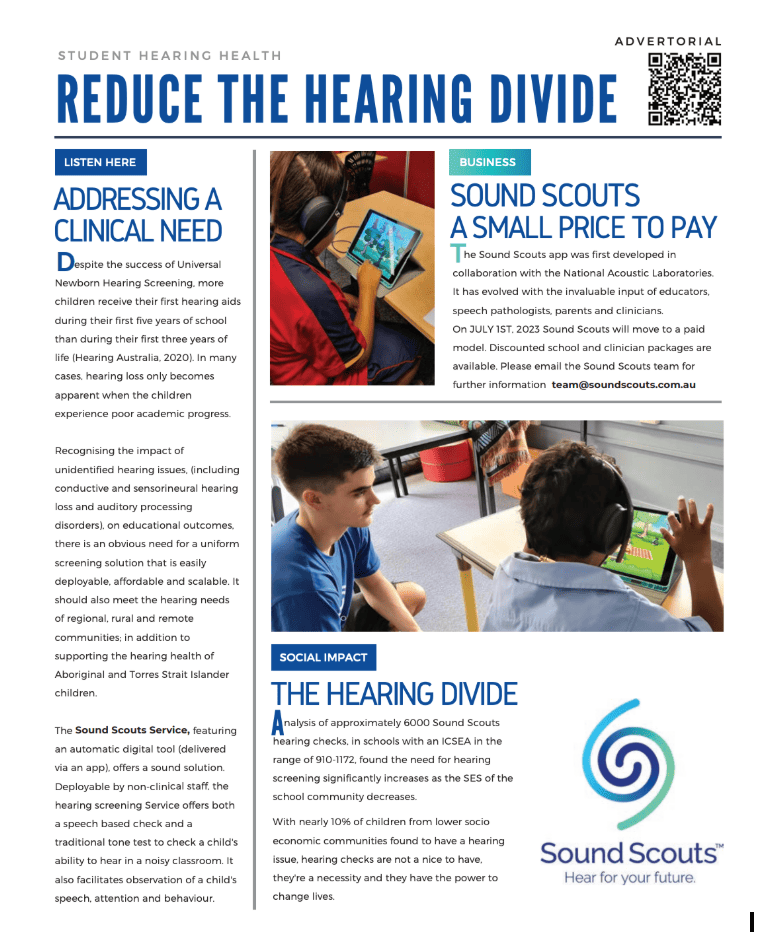
In a world where equal access to education depends on recognising barriers to learning, undetected hearing difficulties can leave children at a disadvantage. In Sound Scouts’ advertorial “Reduce the Hearing Divide,” targeted at parents, educators and school leaders who value children’s wellbeing and educational equity, the organisation persuades readers that accessible hearing screening is essential, encouraging them to invest in its service. This aim is conveyed structurally through a prominent headline and clearly labelled sections that establish appeals to credibility and trust, the strategic placement of photographs that generate appeals to emotion, and a problem–solution structure supported by statistics that develops appeals to reason.
The advertorial’s clear sections and references to experts create appeals to credibility and trust, encouraging readers to see Sound Scouts as a reliable response to children’s hearing needs. [Device] The opening section heading, “Addressing a Clinical Need,” introduces the problem before the product. [Explain] This order presents screening as a response to an existing medical and educational concern, rather than beginning with a sales pitch. [Evaluate] This is persuasive for educators because it makes the service appear to address a genuine need. [Device] Within this section, the citation “Hearing Australia, 2020” follows the claim about delayed identification of hearing difficulties. [Explain] Placing an external reference directly after the claim gives the information a research-based foundation. [Evaluate] This strengthens the text’s authority, although the limited information about the research makes it harder for readers to assess the evidence themselves. [Device] The upper-right section adds an institutional endorsement and a list of contributors, naming the “National Acoustic Laboratories” alongside “educators, speech pathologists, parents and clinicians.” [Explain] Bringing these sources together suggests that the service combines scientific expertise with practical experience. [Evaluate] This reassures readers that the app’s development considers both professional standards and children’s needs. Overall, the structure effectively builds trust by establishing clinical need and expert support around the product, making its promotion appear to offer informed educational guidance.
The placement of the headline, photographs and “Social Impact” section creates appeals to emotion, presenting screening as a way to protect children’s educational opportunities. [Device] The main headline, “Reduce the Hearing Divide,” combines an imperative with a metaphor and occupies the top of the page. [Explain] “Reduce” calls for action, while “divide” suggests an unfair gap between groups of children. Its prominent position frames the information below as a response to inequality. [Evaluate] This appeals to parents and educators who value fairness, connecting screening with their responsibility to support children. [Device] Photographs of children using tablets and headphones appear between the written sections, with the larger image showing an adult beside a child. [Explain] These familiar school scenes give the issue a human focus and present screening as comfortable and supported. [Evaluate] This makes the service feel approachable and may reassure readers concerned about the assessment process. [Device] Beneath the larger photograph, the “Social Impact” section uses the contrast “not a nice to have” but “a necessity.” [Explain] Its placement encourages readers to reinterpret the activity pictured above as essential support rather than an optional extra. [Evaluate] Although this contrast simplifies a complex spending decision, it strengthens the audience’s sense of responsibility. Ultimately, the arrangement moves readers from concern about inequality to reassurance about screening, making support for Sound Scouts feel like a caring and responsible choice.
The advertorial develops appeals to reason through a problem–solution structure supported by practical details and statistics. [Device] The left-hand column first identifies unnoticed hearing difficulties, then calls for screening that is “easily deployable, affordable and scalable,” before introducing Sound Scouts. [Explain] This sequence establishes the requirements of a solution and then presents the service as meeting them. [Evaluate] It is persuasive for school leaders because the product appears to answer clearly defined needs rather than simply offering claimed benefits. [Device] The practical detail that screening can be delivered by “non-clinical staff” follows the explanation of need. [Explain] This addresses a possible barrier to implementation by suggesting that schools do not need specialist clinicians to deliver the checks. [Evaluate] It makes adoption seem manageable, although the absence of training details leaves questions about implementation unanswered. [Device] The lower “Social Impact” section provides statistical evidence, referring to approximately “6000” hearing checks and hearing issues identified in “nearly 10%” of children from lower socioeconomic communities. [Explain] These figures present the problem as measurable and substantial, supporting the need for screening. [Evaluate] They strengthen the argument, but the limited explanation of the research methods restricts readers’ ability to judge their reliability. [Device] The separate “Business” section introduces payment under “A Small Price to Pay.” [Explain] Placing this commercial information alongside clinical and social benefits encourages readers to weigh cost against the consequences of undetected hearing difficulties. [Evaluate] This frames payment as a worthwhile investment, even though the heading assumes affordability without stating a price. Taken together, these structural choices make purchasing the service appear to follow logically from the problem, but they establish the need for screening more convincingly than they prove Sound Scouts is the best available option.
[Effectiveness] This text effectively persuades its audience to consider investing in hearing screening through its use of a clear problem–solution structure and strategically placed expert references and photographs by presenting Sound Scouts as trustworthy and responsive to children’s educational needs. [Limitation] However, the advertorial presents hearing inequality mainly from the company’s perspective. Its structure highlights the benefits of Sound Scouts without directly including the voices of children, families or schools. This shows how media can shape readers’ understanding by promoting one view of an issue while leaving others out.