Whizz Pop Bang: Paper 1 Essay — Interview (N25)
Essay
This interview article from Whizz Pop Bang, a magazine for 6–12-year-olds, presents Ravneet Gill as a baker, TV presenter and psychologist who uses science in her everyday life. The purpose of the article is to encourage young readers to see science as enjoyable and relevant by characterising Rav as a curious child, a resilient learner who improves through experimentation, and a successful professional who applies science in her career. The lively interview format, direct quotations, and colourful scrapbook-style layout work together to make her appear relatable and inspiring.
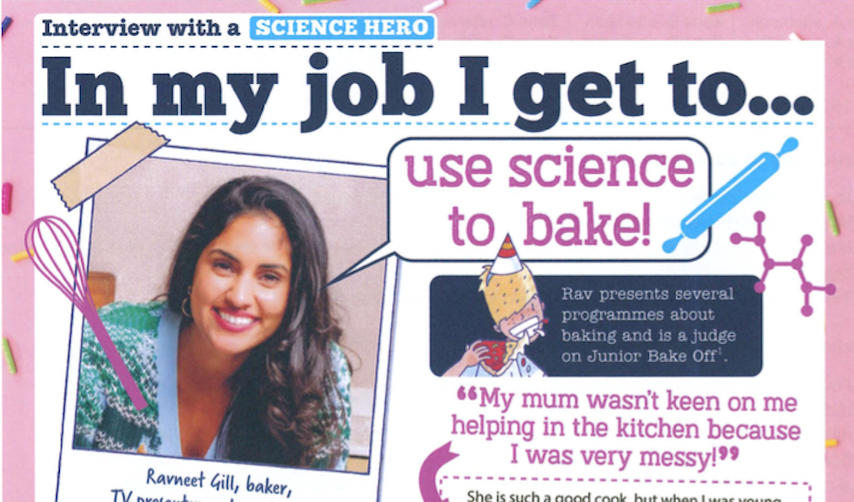
At the beginning of the article, Rav is characterised as someone who has “always LOVED science!” The capitalisation of “LOVED” functions as emphasis, visually intensifying her enthusiasm, while the exclamatory sentence conveys excitement and energy. This emotive tone positions science as joyful rather than intimidating. Rav further explains that biology and chemistry lessons “made me really happy and engaged,” using positive emotive adjectives to associate science with pleasure and fulfilment. The consistent use of first-person narration, “I have always loved science!”, “I studied psychology…”, creates intimacy and immediacy, allowing young readers to feel personally addressed. The visual features reinforce this characterisation. A smiling close-up photograph operates as visual ethos, presenting Rav as warm and approachable. The pastel colour scheme, cupcake and whisk doodles, and speech-bubble quotations create a playful visual motif, aligning science with creativity rather than seriousness. The scrapbook-style layout, with taped photographs and decorative borders, contributes to an informal register, reducing the perceived distance between expert and child reader. Characterising Rav as someone who has always loved science challenges young readers who may assume the subject is difficult, serious or only for certain types of people, encouraging them instead to see it as joyful, creative and within their own reach.
The article then develops Rav’s character by portraying her as resilient and willing to learn through experimentation. The statement “Cooking involves lots of experimenting” is a declarative sentence that explicitly aligns baking with scientific method. Rav’s description of tarts that “explode, or the custard would scramble, burn or spill” uses listing to catalogue failure, normalising mistakes as part of the process. The inclusion of “around 20 attempts” introduces quantification, emphasising perseverance and sustained effort. The clause “but I got it right in the end” creates a contrastive structure, reinforcing the message that persistence leads to success. Scientific understanding is further highlighted through technical and sensory vocabulary: Rav describes monitoring “what happens when you heat sugar to various temperatures,” paying attention to “what the pan sounds like, what the bubbles might look like, what the smells are.” This detailed imagery models scientific observation in accessible terms. Visually, the image of the finished “Pastel de Nata” acts as visual evidence, symbolising improvement after experimentation. The juxtaposition between described failure and polished final product visually reinforces growth. Portraying Rav as resilient and willing to learn through experimentation challenges young readers who may fear making mistakes or believe that failure means they are “bad” at science, encouraging them instead to view trial and error as a normal and valuable part of learning.
Finally, Rav is depicted as a successful professional who integrates science into her career. The bold, capitalised label “SCIENCE HERO” functions as typographical emphasis and creates an aspirational identity. The headline “The highlight of my career was getting the job as a presenter on Junior Bake Off” employs superlative “highlight of my career” to elevate her achievement. Repetition of the idea that she uses science daily, “I use science to help me every day”, operates as repetition for reinforcement, stressing science’s practical relevance. The advice section beginning “If you want to be a scientist when you grow up…” directly addresses the audience through second-person address, while the verbs “spend,” “research,” “read,” and “play” function as imperatives, actively encouraging scientific behaviour. The photographs of Rav on the Junior Bake Off set serve as visual validation, making her success tangible. Her confident full-body pose conveys body language symbolism, reinforcing authority and self-assurance. The bold headline “In my job I get to…” creates anticipation through an ellipsis, generating excitement about career possibilities. This depiction of Rav as a successful professional who integrates science into her career challenges young readers who may believe that science only leads to laboratory jobs or limited opportunities, encouraging them instead to see it as a pathway to exciting, creative and rewarding futures.
Overall, the chronological characterisation of Rav as enthusiastic, persistent and professionally successful promotes science as enjoyable, achievable and rewarding. By combining emotive language, structural progression, repetition, direct address, and aspirational visual imagery, the article transforms science from an abstract school subject into something visible in baking, television and everyday life. However, while the positive and simplified tone makes the article engaging and easy for young readers to understand, it may also seem somewhat one-sided to those who would prefer a more realistic discussion of challenges in order to be fully convinced