IB English Paper 1 — Analysing a Brochure
When you approach a task that has both language and image, but the Guiding Question asks only about language, it’s important to remember that you’re not just analysing the words, you’re analysing the whole text.
Examiners expect you to treat images as deliberate choices, just like diction or structure. In this brochure, the college not only tells us it is inclusive, supportive and academically strong, it also shows us. That means your analysis must consistently link language features to the photographs beside them.
Paper 1 Brochure
Guiding Question
How is language used in an inclusive way to encourage readers to attend the college?
Essay Response
This text is a prospectus-style promotional brochure about a girls’ college, commenting on its values, academic ethos and community environment. It is targeted at prospective students and their parents, specifically those seeking a supportive, high-achieving and values-driven school. The purpose is to persuade readers to attend the college by presenting it as inclusive, nurturing and academically successful. This aim is accomplished through inclusive language, positive emotive diction, aspirational imagery and the strategic use of photographs that visually reinforce belonging, opportunity and shared values.
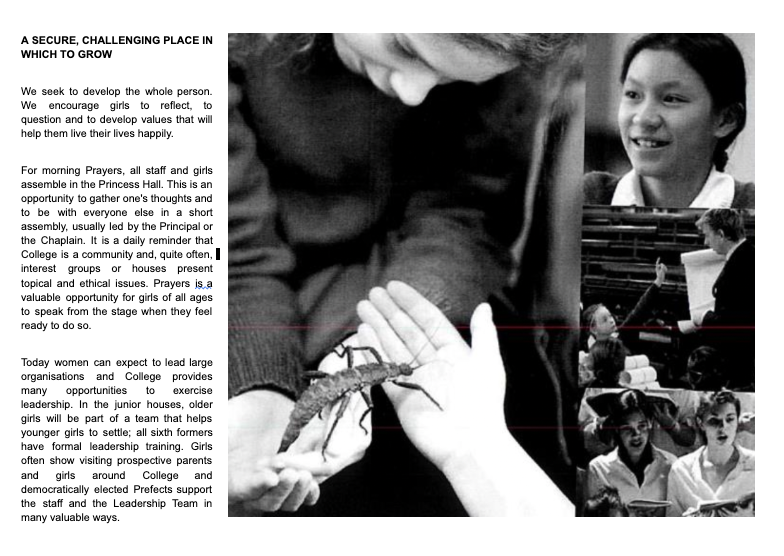
The brochure first constructs inclusivity through collective language that creates a strong sense of belonging, reinforced visually through imagery of students interacting positively. Example 1: The repeated use of the pronoun “we” in “we seek to develop the whole person” positions the school and students as united in a shared mission. Evaluate: This inclusive pronoun reduces distance between staff and students and functions as a rhetorical embrace, dissolving hierarchy. Interpret: Readers are encouraged to feel personally welcomed into a collaborative environment. This message is visually supported by the large central photograph of a student gently holding a stick insect while another student observes closely; the physical proximity and shared focus symbolise cooperation and trust, visually echoing the collective “we.” Example 2: Similarly, phrases such as “all staff and girls assemble” and “everyone at College works hard but we have plenty of fun too” broaden this unity through absolute terms. Evaluate: The quantifiers “all” and “everyone” eliminate exclusion and suggest total participation. Interpret: This reassures parents that their child will belong socially and academically. The smaller photograph of girls singing together further reinforces this idea, as their shared posture and collective engagement visually represent harmony and inclusion. Overall Evaluation: By aligning inclusive pronouns with images of collaboration and shared activity, the brochure directly addresses families’ need for community and belonging, presenting the College as both socially cohesive and emotionally secure.
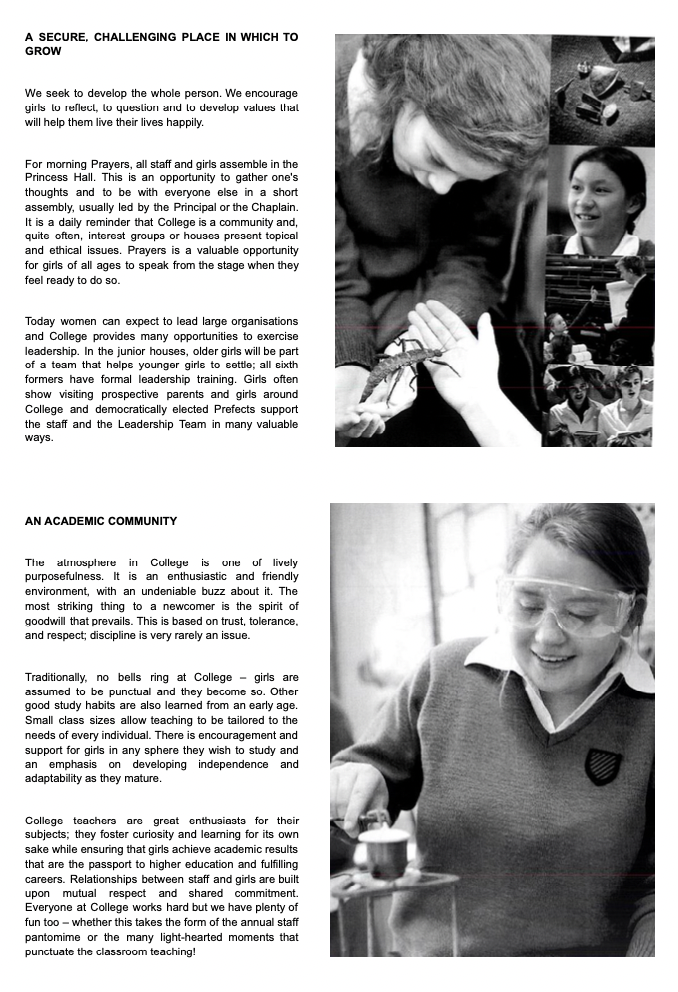
Inclusivity is further reinforced through language that emphasises individual value and equal opportunity, supported by images of diverse academic engagement. Example 1: The statement that teaching is “tailored to the needs of every individual” highlights personalised learning. Evaluate: The universal determiner “every” combined with the singular “individual” balances inclusivity with specificity, suggesting no student is overlooked. Interpret: Readers are likely to believe their unique abilities will be nurtured. This is visually supported by the close-up image of a student conducting a science experiment independently, suggesting focused guidance and personal attention. Example 2: The claim that there is “encouragement and support for girls in any sphere they wish to study” conveys boundless opportunity. Evaluate: The word “any” removes limitation and creates a sense of academic freedom. Interpret: Students are positioned as empowered decision-makers. The variety of photographs, science experiments, music performance, and classroom discussion, visually represents this range of “any sphere,” reinforcing the idea that multiple interests are equally valued. Overall Evaluation: Through combining expansive diction with diverse academic imagery, the brochure appeals to families who seek both personal attention and broad opportunity for their child’s development.
The brochure also promotes an inclusive culture through its emphasis on shared values and mutual respect, strengthened by warm and engaged facial expressions in the images. Example 1: The triadic phrase “trust, tolerance and respect” creates rhythmic emphasis on ethical principles. Evaluate: The rule of three enhances memorability and positions the College within a strong moral framework. Interpret: Readers may infer that their child will be safe and valued. This is visually reinforced by the photograph of students interacting calmly and attentively, their relaxed expressions symbolising comfort and trust. Example 2: The metaphorical phrase “built upon mutual respect and shared commitment” suggests stability and reciprocity. Evaluate: “Built upon” implies a strong foundation, while “mutual” conveys equality rather than dominance. Interpret: Students are positioned as active contributors within a respectful partnership. The image of a teacher guiding students in discussion visually supports this, as the posture and engagement suggest dialogue rather than authoritarian instruction. Overall Evaluation: By pairing ethical language with imagery of positive relationships, the brochure satisfies parents’ desire for a disciplined yet compassionate environment where respect is both stated and visibly practised.
Finally, the language highlights inclusive leadership and future opportunity through aspirational rhetoric, complemented by confident and engaged visual representations. Example 1: The phrase “girls of all ages” stresses participation across year levels. Evaluate: The inclusive categorisation constructs a continuum of growth and opportunity. Interpret: Students are encouraged to envision themselves progressing confidently within the school. The range of images showing students in different activities and likely different year levels visually reinforces this developmental journey. Example 2: The reference to preparation for “higher education and fulfilling careers” employs forward-looking, emotive diction. Evaluate: The adjective “fulfilling” shifts the focus from mere achievement to meaningful success. Interpret: Readers are invited to imagine long-term prosperity and satisfaction. The confident smile of the student conducting the science experiment visually embodies this aspiration, symbolising competence and future readiness. Overall Evaluation: By aligning aspirational language with images of confident, capable students, the brochure effectively meets families’ need for both immediate belonging and long-term success.
Overall, the brochure integrates inclusive language, rhetorical devices and carefully selected photographs to construct a persuasive representation of the College. The visual and verbal elements work synergistically to reinforce unity, individual support, mutual respect and future opportunity, ensuring the target audience perceives the College as a place where every student can belong, thrive and succeed.