Paper 1: Multimodality
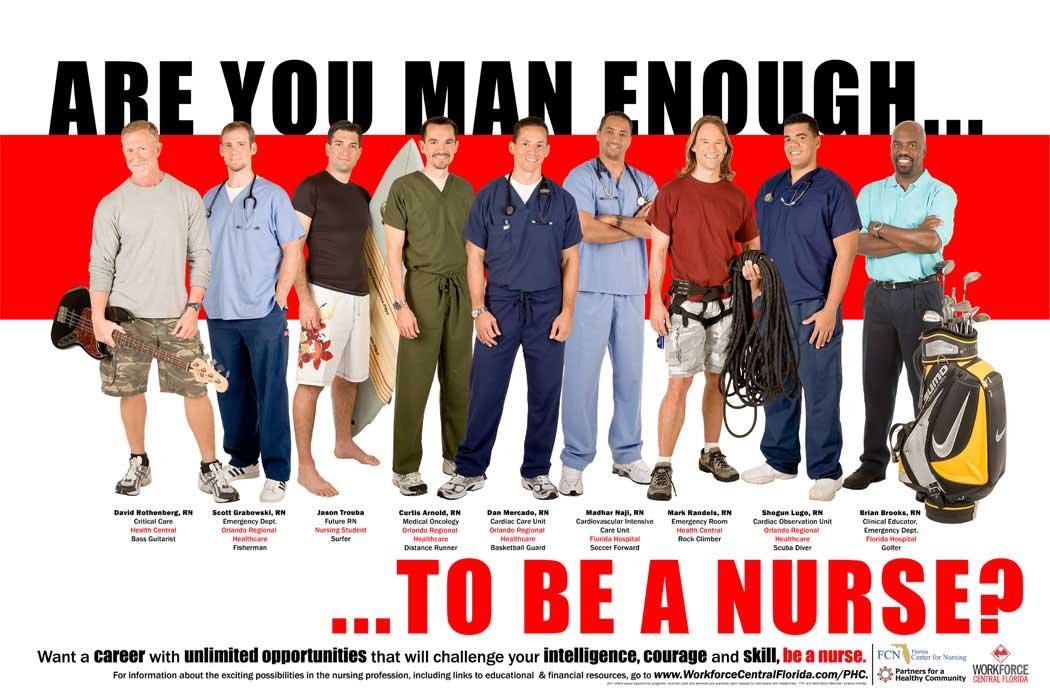
The campaign titled “Are You Man Enough to Be a Nurse?” was launched in 2002 by the Oregon Center for Nursing as a recruitment effort to attract more men into the profession (dailynurse.springerpub.com)
Guiding Question
- How do text and image work together to convey the ad’s purpose?
Essay
This text is a recruitment advertisement about men in nursing, commenting on traditional stereotypes that portray nursing as a feminine profession. It is targeted at men, specifically those who may value strength, ambition, and traditional ideas of masculinity when choosing a career. The purpose is to persuade men to consider nursing as a challenging, respectable, and masculine profession. This aim is accomplished through the ad’s conceptual structure, strategic layout, confident visuals, bold language, and, most importantly, the way text and image interact to reshape masculinity and align it with nursing.
The ad uses conceptual structure multimodally by creating a dialogue between the challenging headline and the visual representation of male nurses. The question, “Are you man enough… to be a nurse?”, introduces doubt about whether nursing fits traditional masculinity. This textual challenge is immediately answered visually by the men standing confidently in scrubs at the center of the advertisement. Their muscular builds, upright posture, and direct gaze function as visual proof that they are, in fact, “man enough.” At the same time, the inclusion of traditionally masculine hobbies alongside their nursing roles connects the words of the headline to concrete imagery. The text frames nursing as a test of masculinity, while the image reassures viewers that masculinity remains intact. Together, they conceptually redefine nursing not as a contradiction to manhood, but as an arena in which masculinity can be demonstrated.
The layout strengthens this message by physically positioning text and image so they work together to guide interpretation. The bold words “Are you man enough” appear at the top, while “to be a nurse?” appears at the bottom, visually enclosing the men in the center. This framing makes the male figures the visual answer to the textual question. The red banner behind them adds intensity to both the words and the bodies, visually amplifying the sense of challenge created by the headline. The sports equipment placed beside each man works alongside the text by visually reinforcing the idea of strength and toughness implied by “man enough.” The viewer’s eye moves from the headline, to the men, to the supporting text at the bottom, creating a structured flow in which the image consistently supports and clarifies the written message. Through this careful arrangement, layout ensures that text and image cannot be separated; meaning is produced through their placement together.
The confident visuals further enhance the persuasive impact of the written language. While the text claims nursing requires “intelligence,” “courage,” and “skill,” the men’s assertive poses visually embody these qualities. Their direct eye contact mirrors the confrontational tone of the headline, making the challenge feel personal and immediate. The medical scrubs and stethoscopes anchor the men firmly within the nursing profession, while the masculine props visually soften any perceived conflict between masculinity and care work. In this way, the image does not simply decorate the text; it legitimises it. The visual display of athletic bodies and masculine hobbies works to stabilise the potentially threatening idea introduced by the words. Together, text and image create reassurance: the written challenge questions masculinity, and the visual response restores it.
The bold language of the advertisement relies on the images to fully achieve its persuasive force. The rhetorical question “Are you man enough?” taps into cultural expectations that masculinity must be proven. However, without the visual presence of strong, confident male nurses, the question could reinforce doubt rather than resolve it. The images ensure that the phrase becomes aspirational rather than accusatory. Similarly, terms like “intelligence,” “courage,” and “unlimited opportunities” gain credibility through the professional appearance of the men in scrubs. The visual diversity of the group broadens the textual claim that nursing is open to many kinds of men. Here, the language creates the ideological challenge, and the imagery supplies the evidence needed to make that challenge persuasive.
The advertisement achieves its purpose primarily through its strategic use of multimodality. The headline destabilizes traditional assumptions about masculinity, while the visuals reconstruct masculinity in a way that accommodates nursing. The sports equipment visually reinforces the phrase “man enough,” and the men’s confident stance echoes the bold tone of the words. Each mode strengthens the other: the text introduces the idea that nursing can be masculine, and the image makes that idea believable. However, this multimodal strategy also reveals a limitation. By relying on hyper-masculine imagery to support its message, the advertisement reinforces the notion that masculinity must be preserved and protected, rather than questioning why care work is feminized in the first place.
Overall, the advertisement effectively uses text and image together to persuade men to consider nursing as a profession. The bold question, “Are you man enough… to be a nurse?”, works in direct partnership with the confident visual portrayal of male nurses to frame the career as a test of strength and capability. Yet the same multimodal strategy depends on traditional ideals of masculinity, suggesting that while the campaign may succeed in recruitment, it challenges stereotypes only by reshaping them rather than dismantling them.