IB English Paper 2 — Symbols
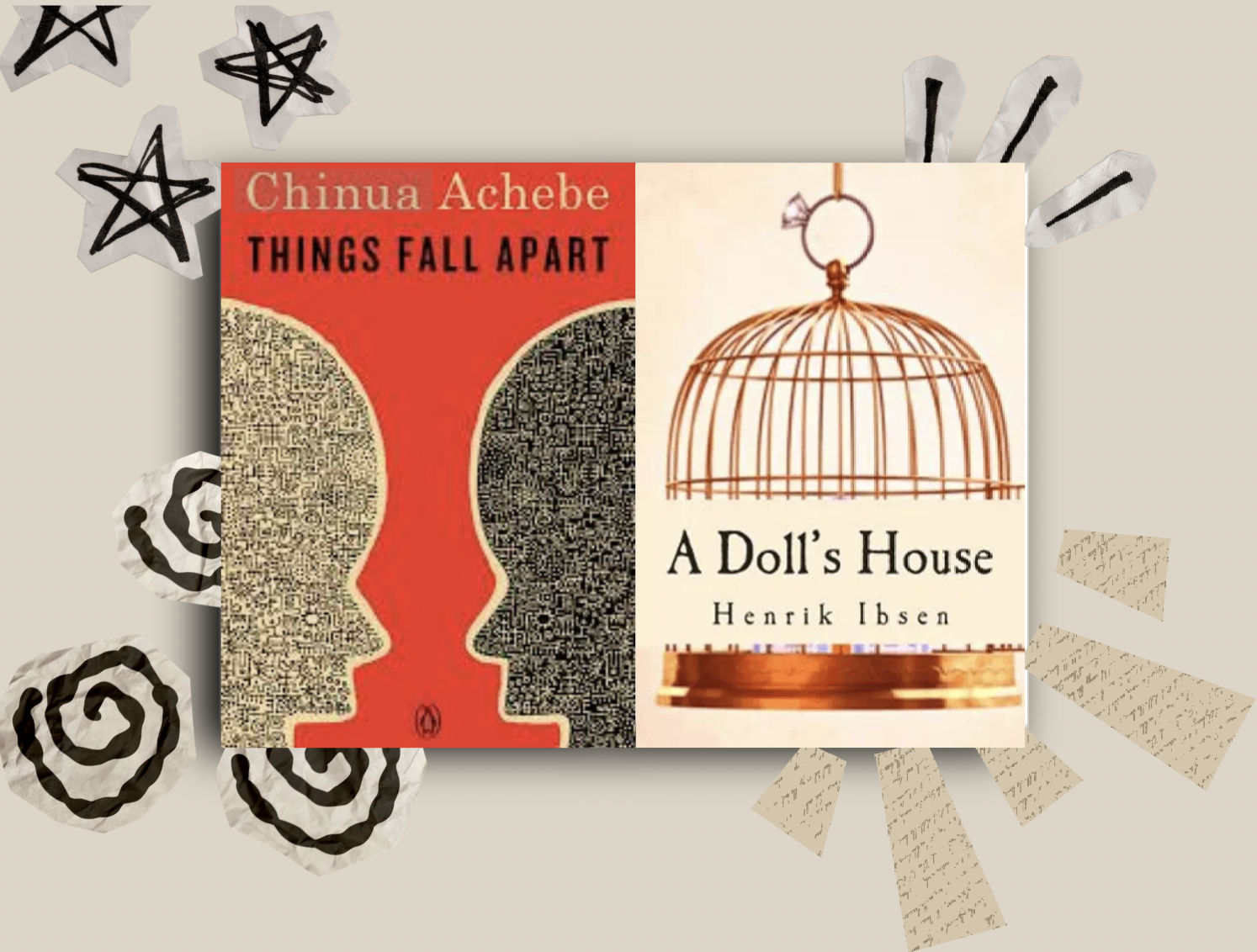
In both A Doll’s House by Henrik Ibsen and Things Fall Apart by Chinua Achebe, symbolism is central to the authors’ exploration of identity, societal expectation, and the collapse of established structures. While Ibsen employs domestic symbols to expose the artificial foundations of patriarchal marriage and individual self-delusion, Achebe uses culturally embedded symbols to represent the strength and eventual fragmentation of Igbo society. Through carefully developed symbolic motifs, ranging from the Christmas tree and the tarantella to yams and fire, both authors illuminate the tensions between individual agency and social systems, yet they do so within vastly different cultural and historical frameworks. Ultimately, symbolism in both works reveals the instability of identities constructed by tradition and power.
Both Ibsen and Achebe use symbolic objects to reflect the precarious foundations of social identity and status. In A Doll’s House, the Christmas tree initially symbolizes domestic warmth and Nora’s role as the decorative center of the household. At the beginning of the play, the tree is vibrant and full of promise, mirroring Nora’s apparent happiness and the illusion of a harmonious marriage. However, by Act II, the tree is stripped and disheveled, with burnt-down candles, an image that parallels Nora’s psychological deterioration as her secret loan threatens exposure. The tree’s decline symbolically exposes the artificiality of the Helmers’ domestic life: just as the tree is an ornament brought in temporarily for display, Nora herself has been treated as a decorative possession. Similarly, Nora’s macaroons symbolize small acts of rebellion within a system of control. Torvald forbids her from eating them, ostensibly to protect her teeth, yet the restriction reveals his paternalistic dominance. Nora’s secret consumption becomes a symbol of suppressed autonomy; trivial on the surface, it reflects deeper deceptions within the marriage. In contrast, Achebe uses culturally significant symbols such as the yam to represent masculine achievement and social worth. Yam cultivation in Things Fall Apart is not merely agricultural labor but a symbol of strength, prosperity, and manhood. Okonkwo’s identity is inseparable from his success as a yam farmer; his barns signify his status within the clan. However, when exile disrupts his progress, the symbolic loss of continuity in yam production mirrors his declining influence. Additionally, the sacred python functions as a symbol of religious tradition and communal cohesion. Its desecration by a Christian convert represents not just religious conflict but the erosion of shared belief systems that once unified the clan. Thus, while Ibsen’s domestic symbols reveal the fragility of personal identity within marriage, Achebe’s cultural symbols expose the vulnerability of collective identity under colonial pressure.
While both authors use symbols to critique systems of authority, Ibsen focuses on psychological and domestic entrapment, whereas Achebe foregrounds cultural and spiritual structures. In Ibsen’s play, the tarantella dance becomes a powerful symbol of Nora’s desperation and performance within marriage. On the surface, the dance is entertainment for Torvald at the Stenborgs’ ball, but its frantic intensity reflects Nora’s internal turmoil and her attempt to delay Torvald from reading Krogstad’s letter. The tarantella traditionally symbolizes a dance meant to expel poison from the body, and metaphorically, Nora is attempting to purge the “poison” of her secret. However, she remains trapped in the performative role Torvald has assigned her, “my little skylark”, highlighting how her identity has been shaped as spectacle rather than substance. Similarly, the letterbox symbolizes patriarchal control and restricted access to truth. Torvald’s possession of the key underscores his authority, and Nora’s anxiety over the letter’s presence illustrates her powerlessness within the structure of marriage. The letterbox thus represents the barrier between appearance and reality, controlled entirely by the husband. In Achebe’s novel, the egwugwu serve as symbolic embodiments of ancestral authority and communal justice. They are not merely masked performers but living representations of tradition and collective memory. When Enoch unmasks an egwugwu, it symbolizes the exposure and humiliation of Igbo spiritual authority under colonial intrusion. This act parallels Nora’s symbolic unmasking of her marriage; however, in Achebe’s context, it marks the beginning of irreversible communal fragmentation. Additionally, the church built in the Evil Forest symbolizes both subversion and transformation. Traditionally, the Evil Forest is a space of death and taboo, but the missionaries’ survival there challenges Igbo cosmology. The survival of the church in this space destabilizes traditional belief systems and symbolizes the creeping power of colonial ideology. Therefore, while Ibsen uses symbols to critique the oppressive structures of marriage, Achebe uses them to dramatize the collision between indigenous belief systems and colonial modernity.
Ultimately, both writers use recurring symbolic motifs to foreshadow irreversible rupture, though the scale differs from individual emancipation to societal collapse. In A Doll’s House, the slammed door at the end of the play functions as the most famous symbol of all: it represents Nora’s rejection of her doll-like existence and her assertion of individuality. The sound reverberates beyond the domestic sphere, symbolizing the broader challenge to 19th-century gender norms. Similarly, Nora’s wedding ring, which she returns to Torvald, symbolizes the dissolution of marital bonds and the dismantling of socially constructed identity. By relinquishing the ring, she rejects not only Torvald but the entire ideological framework that defined her. In contrast, Achebe’s final symbolic image is Okonkwo’s body hanging from a tree, a tragic inversion of his earlier image as a “roaring flame.” Fire throughout the novel symbolizes Okonkwo’s fierce masculinity and destructive intensity. He associates fire with strength, yet fire also consumes and destroys. In the end, his suicide, an abomination in Igbo culture, extinguishes his symbolic flame and represents the collapse of both personal pride and communal cohesion. Furthermore, the District Commissioner’s plan to reduce Okonkwo’s life to a paragraph in The Pacification of the Primitive Tribes of the Lower Niger symbolizes colonial erasure. The reduction of complex human and cultural experience into a dismissive imperial narrative underscores the final silencing of Igbo agency. Thus, while Ibsen’s symbolism culminates in individual awakening, Achebe’s symbolism culminates in tragic disintegration.
In conclusion, both Ibsen and Achebe deploy symbolism to interrogate systems of power and identity, yet their approaches differ in scope and cultural focus. Ibsen’s domestic symbols, such as the Christmas tree, tarantella, and slammed door, expose the constructed and performative nature of patriarchal marriage and culminate in personal emancipation. Achebe’s culturally embedded symbols, such as yams, the sacred python, the egwugwu, and fire, trace the rise and fragmentation of Igbo society under colonial pressure. Through these symbols, both authors reveal that structures once believed stable, marriage, religion, tradition, are in fact vulnerable to internal contradictions and external forces. Ultimately, their symbolic landscapes illuminate the cost of transformation, whether it be the liberation of one woman or the tragic unraveling of an entire culture.