IB English A Paper 1 — Effect vs Evaluation: Crit B
Effect vs Evaluation
When analysing persuasive texts, students often confuse effect with evaluation (IB English Crit B). Effect explains what the language does to the audience, while evaluation judges how successful that strategy is.
Effect is usually signposted through action verbs such as encourages, reinforces, positions, or reassures, as it explains what the language does to the audience.
Evaluation, on the other hand, is signposted through judgement words such as effective, persuasive, convincing, or limited, as it assesses how successful that strategy is.
Quick distinction:
Effect = action words (what it does):
fosters, encourages, reassures, positions, aligns, reinforces, invites, makes, highlights, suggests
Evaluation = judgement words (how well it works):
effective, strengthens, enhances, weakens, reduces, convincing, persuasive, successful, limited, idealised
Using this college brochure as an example, the essay that follows demonstrates the difference between identifying impact and assessing effectiveness.
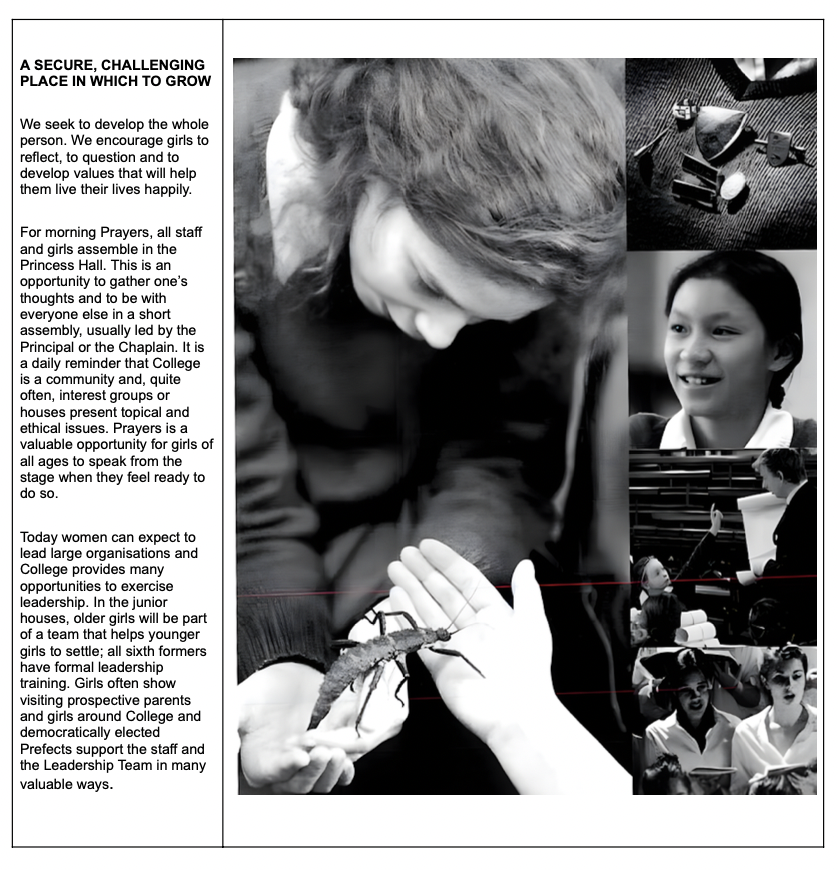

Guiding Question — How is language used in an inclusive way to encourage readers to attend the college?
IB English Paper 1 Essay
This text is a promotional brochure for a girls’ college that highlights its supportive environment, leadership opportunities, and academic strengths. It is aimed at prospective students and their parents, particularly those looking for a school that is both high-achieving and nurturing. Its purpose is to persuade families to choose the college. To achieve this, the brochure constructs a strong sense of inclusivity through collective language, collaborative representations of leadership, partnership-based academic values, and carefully composed imagery, presenting the school as a unified and supportive community built on shared success. Importantly, this inclusivity is also framed as a form of female empowerment, positioning the college as a space where girls are not only supported within a unified community, but also prepared for ambitious academic and professional futures.
The brochure first establishes inclusivity through its use of collective language to create a sense of shared identity. Analysis: The brochure creates a strong sense of togetherness through the repeated use of the first-person plural pronoun “we” in phrases like “We seek to develop the whole person.” This inclusive pronoun aligns staff and students within the same group, breaking down hierarchical distance. References to “community” function as a collective noun, evoking unity and belonging, while the term “everyone” removes exclusivity and reinforces equality. Together, this inclusive lexis constructs a shared identity rather than a divided institution. Effect:By positioning readers inside this collective through inclusive diction, the brochure fosters reassurance and belonging, making enrolment feel like joining a supportive network rather than simply attending a school. Evaluation:This strategy is highly effective for parents who prioritise school culture and emotional wellbeing, though the consistently idealised tone may appear slightly constructed to more critical audiences.
The brochure then develops this sense of inclusivity by presenting leadership as collaborative and accessible. Analysis:The brochure then extends this inclusive framework to leadership, representing it as collaborative rather than elite. Phrases like “part of a team” draw on a semantic field of cooperation, while the verb phrase “helps younger girls” carries altruistic connotations and a mentorship register, reframing authority as service. The phrase “democratically elected Prefects” introduces democratic lexis, suggesting fairness, representation, and shared agency. These language devices collectively position leadership as embedded within the community structure rather than reserved for a select few. Effect: Through this participatory and democratic language, prospective students are encouraged to see themselves as active contributors, not passive recipients of authority. Evaluation: This inclusive construction of leadership strengthens the brochure’s persuasive appeal, especially for families who value empowerment and character development; however, the absence of specific examples or measurable achievements slightly weakens its logical appeal.
Inclusivity is further reinforced in the academic section, where learning is framed as a shared and supportive experience. Analysis: This inclusive ethos continues in the academic section through carefully chosen positive adjectival diction, such as “enthusiastic and friendly environment,” which creates a semantic field of warmth. The triplet “trust, tolerance and respect” employs the rule of three to emphasise core shared values, while “mutual respect and shared commitment” uses reciprocal language and inclusive modifiers to highlight equality between staff and students. This lexis reframes education as a partnership rather than a top-down hierarchy. Effect: By embedding academic success within this language of cooperation and relational harmony, the brochure reassures readers that achievement is both supported and attainable. Evaluation: While this blend of aspirational academic language and inclusive rhetoric enhances credibility, the limited use of statistics or measurable outcomes may reduce its persuasiveness for readers who prioritise empirical evidence.
The brochure’s visual elements also play a key role in reinforcing its message of inclusivity. Analysis: The images reinforce inclusivity through deliberate visual composition, salience, and symbolic imagery. The centrally placed photograph acts as a dominant image, visually anchoring the page. The careful transfer of the insect operates as a visual metaphor for trust and guided learning, while the open palm symbolises receptivity. The close body positioning and proxemics suggest cooperation and shared focus. Surrounding images, arranged in a cohesive collage layout, use group framing to depict students working and performing together, reinforcing collective participation rather than isolation. Effect: Through this layered visual rhetoric, abstract ideas like trust and community become visible and concrete. Evaluation: As a result, the imagery strengthens the brochure’s emotional appeal and visually substantiates its inclusive claims, although the carefully curated presentation may appear somewhat idealised to more sceptical viewers.
While the brochure consistently promotes inclusivity, it also subtly reframes it as a vehicle for female empowerment, positioning the college as a space where girls are both nurtured and prepared for ambitious futures.Analysis:The brochure constructs inclusivity not simply as community belonging, but as a form of female empowerment. Through its use of positive adjectival diction and a semantic field of nurture, the college is framed as emotionally supportive, reassuring parents that their daughters will be cared for as individuals. Aspirational phrases such as women leading “large organisations” draw on empowering lexis and a future-oriented register, positioning students as academically capable and professionally ambitious. The emphasis on leadership opportunities employs confident declarative statements, constructing girls as assured and competent leaders. Effect:This reassures parents that their daughters will be both supported and empowered to succeed. Evaluation:This is highly persuasive, as it successfully balances warmth with ambition, appealing strongly to families who want both wellbeing and academic excellence for their daughters.
Overall, through its consistent use of inclusive language and visual framing, the brochure invites prospective students and their parents to imagine themselves as part of a supportive and unified school community. At the same time, it frames this inclusivity as a form of female empowerment, positioning the college as a space where girls are nurtured, confident, and prepared for ambitious academic and professional futures. However, because the brochure focuses more on inspiring ideas of empowerment than on clear academic proof, it may be less convincing for families who want to see measurable results, especially those who feel that empowerment needs to be backed up by strong outcomes, not just positive messaging.