How to Write a Killer Paper 1 Introduction — for IB Lit students
You know that sinking feeling: you’ve just read the unseen text, your mind is buzzing with reactions, but when you start writing your intro, it comes out flat.
“This passage explores themes of...” or “The writer uses devices to convey...” You cringe a little. It sounds like every other student’s opening, and nothing like the complexity you actually sensed.
The problem isn’t your insight. It’s that you’ve been taught to report on literature, not interrogate it. And in Paper 1, that difference is everything.
Let’s fix your introduction so it finally sounds like you, your intelligence, your attention, your voice, right from sentence one.
Weak Introduction
“This poem by Sylvia Plath is about how society pressures women to conform to traditional roles, especially in marriage. It uses questions and imagery of body parts to show how women are treated like objects. The tone is sarcastic, and the speaker seems angry. Plath wrote this in the 1960s, when feminism was growing, so she is criticizing outdated gender norms.”
Examiner Comments
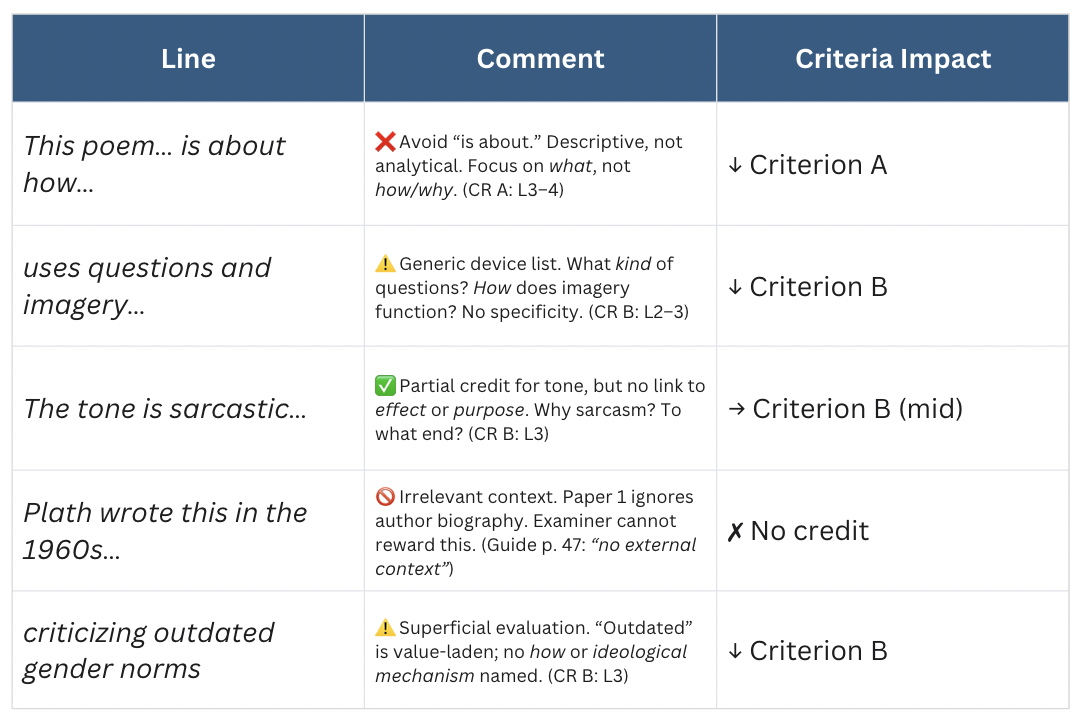
Examiner’s Overall Comment
→ “Competent understanding but limited analysis; relies on summary and generalization.” (Typical feedback: “Develop interpretation beyond the obvious; focus on authorial choices, not author intention.”)
Strong Introduction
“Through dehumanizing interrogative syntax and clinical cataloguing of prosthetic body parts, Plath constructs the marriage market as a eugenic audit, not to satirize individual prejudice, but to expose how patriarchal institutions commodify female bodies under the guise of “fitness”, revealing how systemic ableism and sexism converge to reduce personhood to functional utility.”
Examiner Comments
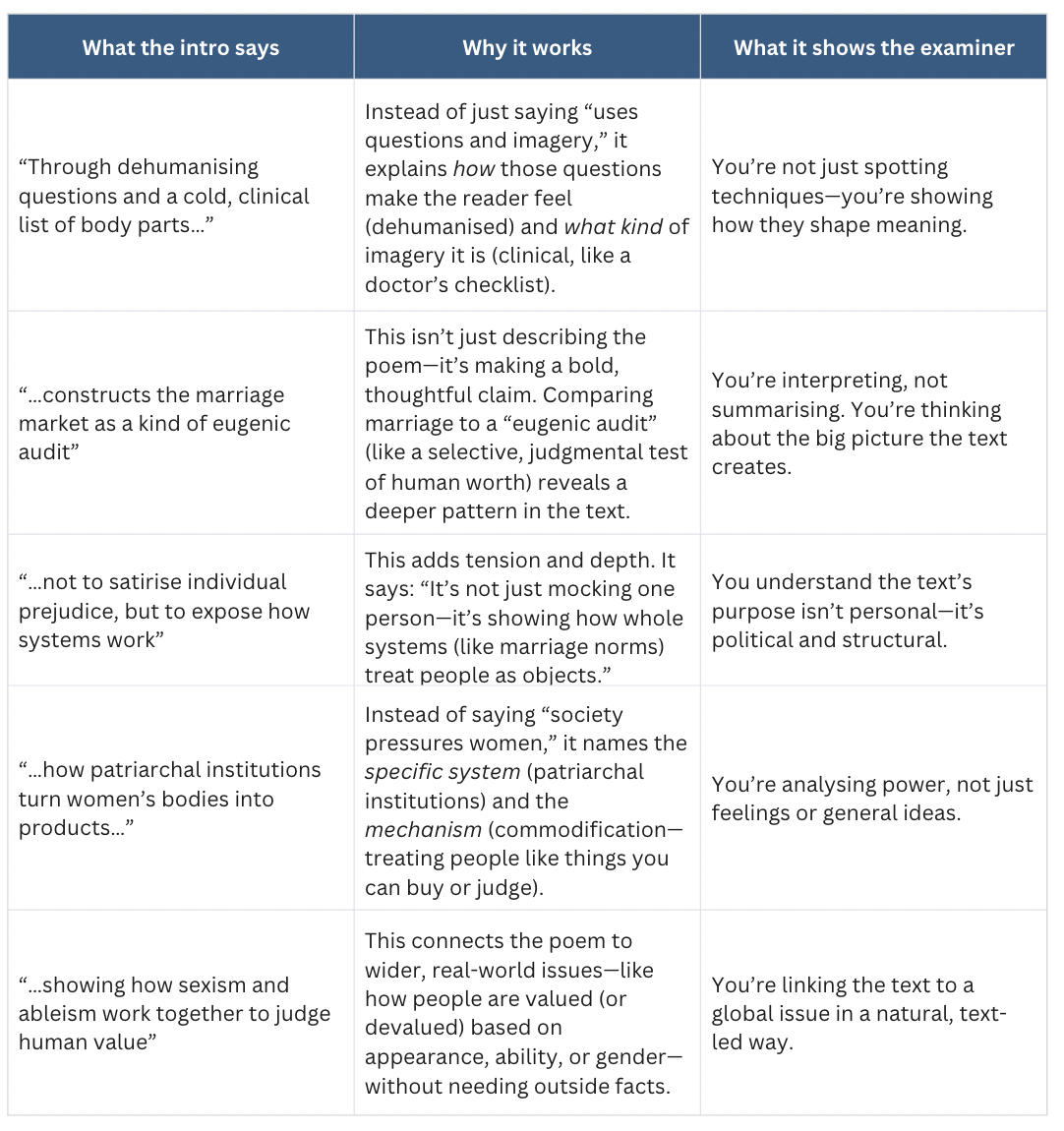
Examiner’s Overall Comment
→ “Perceptive understanding of how meaning is constructed; sustained evaluation of authorial choices in relation to purpose and context.”
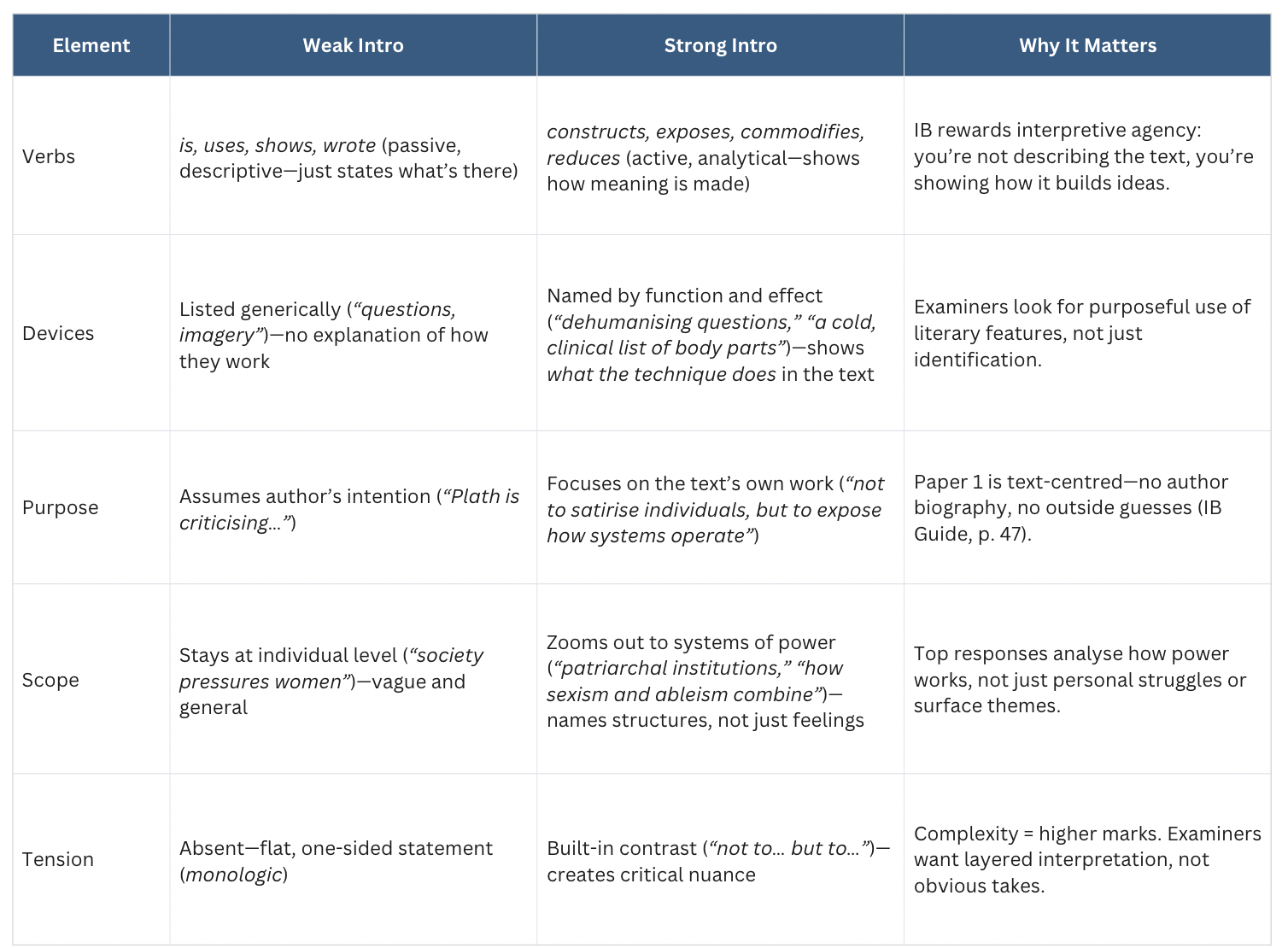
Key Contrasts: What Changed?
Here’s the truth: examiners aren’t waiting for you to decode the author’s secret message or label a “theme.”
They’re listening for whether you can think with the text, track how a phrase unsettles, how a rhythm controls, how a metaphor quietly builds a worldview. Your frustration isn’t a lack of skill; it’s a mismatch between what you feel and how you’ve been told to write.
But now you know: ditch the “This text is about…” habit. Replace it with “Through…, the text constructs…” or “By doing X, the passage enacts Y.” That small shift puts you in charge, not as a summariser, but as an analyst.
That’s where your best Paper 1 work begins, not with what the text says, but with what it does, and how brilliantly you can show it.