Paper 1 Analysis — Open Letter
Read the the full open letter here.
This text is an open letter calling for the protection of the Amazon rainforest, written in response to possible environmental agreements between the United States and Brazil under President Jair Bolsonaro. It is addressed directly to U.S. President Joe Biden and aims to prevent him from entering into any agreement that does not reduce deforestation or protect Indigenous rights. Through the strategic use of appeal to authority, emotion, and logical reasoning, supported by inclusive language, direct address, emotive diction, statistical evidence, visual imagery, and a respectful but firm tone, the writers frame environmental protection as both a political and moral responsibility.
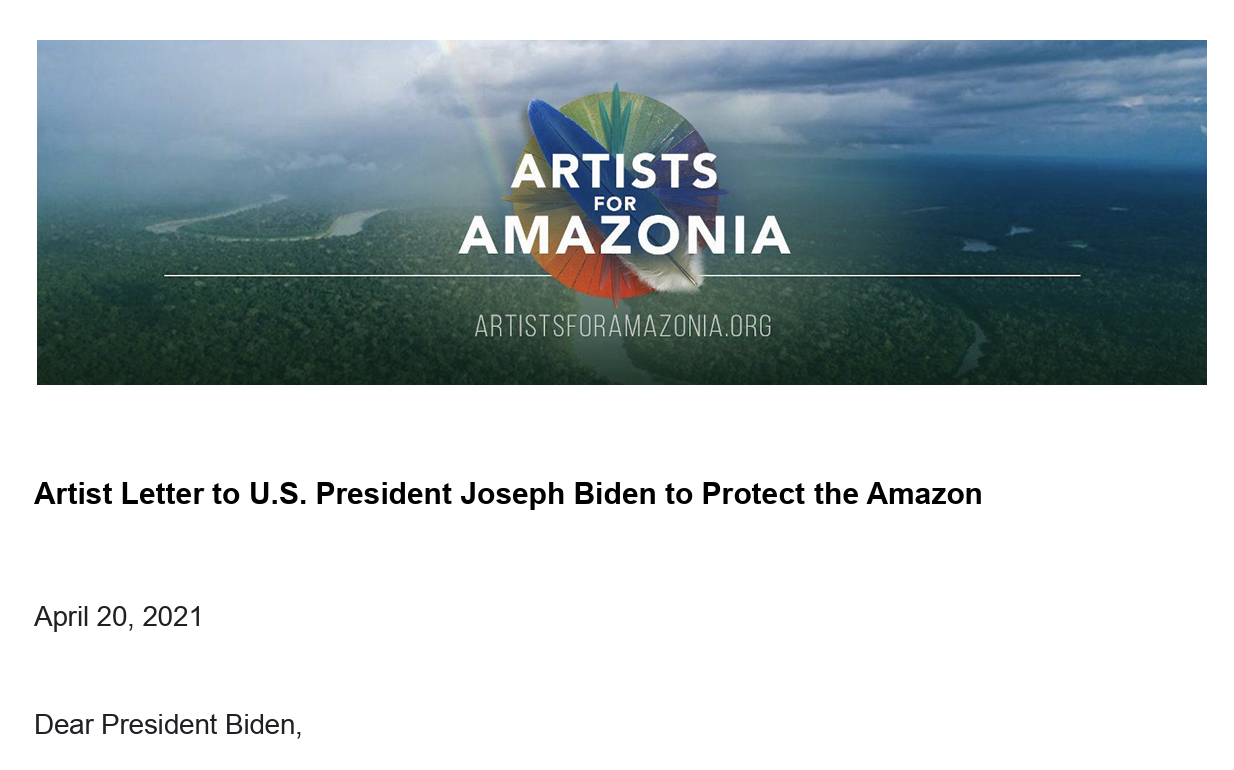
The letter strategically establishes credibility to frame environmental protection as a public test of presidential leadership. This is achieved through an appeal to authority, as the writers present a coalition of internationally recognised artists, including Leonardo DiCaprio, Jane Fonda, Katy Perry, and Mark Ruffalo, whose global visibility signals widespread international attention. The bold, visual branding “ARTISTS FOR AMAZONIA” banner reinforces unity and professionalism, while the long list of signatories strengthens collective authority. In addition, the repeated direct address (“Dear President Biden” and “your Administration”) personalises accountability, and the opening acknowledgment of Biden’s climate commitments establishes a respectful but firm tone. As a result, the issue is moved into the public sphere, encouraging the President to consider how his decision will be judged globally and positioning his response as a measure of his leadership.
The letter relies on emotional appeal to frame environmental protection as an urgent moral issue. This is achieved through emotive language, including phrases such as “climate emergency,” “violated,” and “burned with impunity,” which generate alarm and moral outrage. An urgent and alarmist tone is reinforced through expressions like “nearing a tipping point,” “systematically rolled back,” and “tripled,” emphasising immediacy and seriousness. The sweeping aerial rainforest image (visual imagery) further strengthens this emotional appeal. The high-angle, expansive view highlights the scale of the Amazon, while its rich green tones emphasise natural beauty and ecological value. By presenting the forest as vast yet vulnerable, the image creates both awe and fragility, encouraging readers to feel protective. Its placement at the beginning of the letter shapes the reader’s emotional response before the argument unfolds, reinforcing urgency from the outset. Furthermore, the use of inclusive language, such as “we” and “collectively,” frames climate change as a shared global crisis. By combining strong language with powerful imagery, the writers make inaction appear morally wrong, increasing pressure on the President to act responsibly.
Alongside emotional appeals, the writers strategically incorporate logical reasoning to present their argument as evidence-based and policy-focused. This is shown through the use of statistical evidence, noting that deforestation rates have “tripled” and environmental protections have been “systematically rolled back,” which grounds their claims in measurable fact. The argument follows a clear cause-and-effect structure: if deforestation is increasing and Indigenous rights are being violated, then entering into an agreement without safeguards would likely be ineffective or harmful. The writers also propose a constructive alternative, urging continued dialogue with civil society and Indigenous leaders before releasing funds, which demonstrates solution-focused reasoning rather than simple criticism. As a result, this logical structure suggests that making a deal without safeguards would contradict the evidence presented, encouraging the President to choose a policy that appears rational and consistent with his stated climate commitments.
Overall, the letter is persuasive because it blends strong ethical authority, emotional urgency, and logical reasoning to create a unified and compelling appeal. However, its firm and occasionally critical tone may slightly reduce its effectiveness, as it risks sounding more questioning than collaborative when addressing the President.