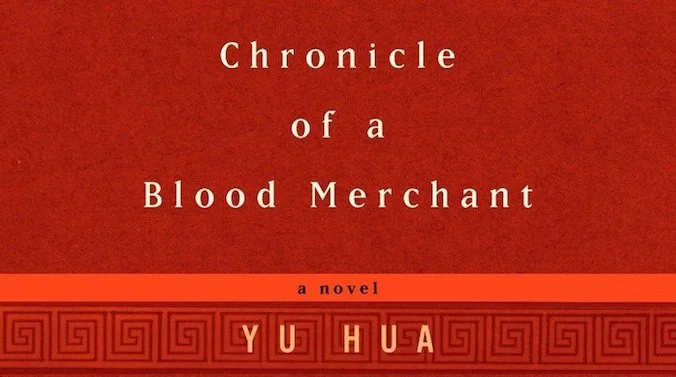
Notes on Chronicle of a Blood Merchant by Yu Hua
Author’s Stance
politics and society dehumanize yet ordinary compassion and courage resist
Global Issue
human resilience and dignity under social and economic oppression
Title
The title Chronicle of a Blood Merchant reflects Yu Hua’s commentary on the political and social atmosphere of mid‑20th‑century China, where ordinary people were often forced to sacrifice their bodies and dignity to survive under oppressive state systems; “selling blood” becomes a metaphor for how individuals were drained, physically, emotionally, and morally, by political and social demands.
The word “Chronicles” in the title Chronicle of a Blood Merchant is significant because it suggests that the novel is not just one story, but a record of an entire life and era—a step‑by‑step account of how an ordinary man’s personal sacrifices mirror the collective suffering of a generation.
It turns Xu Sanguan’s private struggles into a historical testimony, showing how common people’s daily hardships, love, and endurance become the true “chronicles” of China’s social and political history.
Author’s Message
Yu Hua’s message in Chronicle of a Blood Merchant is that political systems and social pressures can strip people of dignity, turning life and love into commodities, yet the ordinary human capacity for compassion, endurance, and moral courage remains the most powerful resistance to dehumanization.
Overall Summary
Through Xu Sanguan’s life, from hope to humiliation to resilience, Yu Hua chronicles how ordinary people endured decades of political chaos and poverty in Mao‑era China, revealing the cost of survival and the quiet heroism of compassion in a dehumanising system.
Themes / Global Issues
Sacrifice and Survival – showing how ordinary people must give of themselves, sometimes literally, to endure political and social hardship.
The Value of Human Life – exploring how poverty and ideology turn life and body into commodities.
Family and Love amid Hardship – revealing how affection and loyalty persist even in dehumanising conditions.
Political Oppression and Absurdity – exposing how Mao‑era systems drained individuality and dignity from people’s lives.
Moral Ambiguity – illustrating how “right” and “wrong” blur when survival depends on compromise.
Resilience and Humanity – affirming that compassion and endurance can survive even under crushing social control.
Critique of Ideology and Authority – highlighting how blind obedience to political power leads to suffering and moral decay.
Yu Hua’s Key Stylistic Devices
Black Humor – using dark comedy to expose the absurdity and cruelty of political and social life.
Irony – contrasting noble intentions with tragic or ridiculous outcomes to criticize blind faith in authority.
Symbolism – treating blood as a symbol of life, sacrifice, humanity, and the draining effects of totalitarianism.
Realism with Satirical Elements – depicting daily life and hardship in vivid, believable detail while subtly mocking social systems.
Plain, Colloquial Language – reflecting the voice of ordinary working‑class people to make political critique more accessible.
Repetition and Cyclical Structure – mirroring how suffering and survival endlessly repeat under oppressive regimes.
Emotionally Restrained Narration – describing tragedy in a calm, detached tone to heighten its emotional power.
Juxtaposition of Humor and Tragedy – blending laughter and pain to reflect the contradictions of human endurance.
Moral Allegory – using one family’s story as a microcosm of China’s larger political and moral landscape.
Characters
Xu Sanguan – The everyman of Mao‑era China; represents sacrifice, endurance, and the dehumanizing effects of survival under political and economic pressure.
Xu Yulan – His wife; embodies love, loyalty, and the moral compromises women make to protect family and dignity.
Yile (First Joy) – The eldest son, not Xu Sanguan’s biological child; symbolizes identity, shame, and the cost of political and social hypocrisy.
Erle (Second Joy) – The second son; represents obedience and generational conflict—how children inherit both suffering and moral confusion from their parents.
Sanle (Third Joy) – The youngest son; reflects innocence and continuity, suggesting that despite hardship, life and hope persist.
He Xiaoyong – Yule’s biological father; symbolizes moral cowardice, selfishness, and the corrupt opportunism bred by political and social decay.
Blood Chief Li – The hospital official who buys blood; stands for state corruption and the commodification of human life.
Blacksmith Fang – Neighbor involved in Yile’s conflict; represents rural justice and the social codes of survival in an unstable society.
Lin Fenfang – Former co‑worker and Xu Sanguan’s brief affair; embodies temptation, moral weakness, and human fallibility amid repression.
Xu Yulan’s father – Old‑generation figure; represents traditional family values and patriarchal constraint in a rapidly changing political world.
Symbols
Blood – the central symbol; represents life, sacrifice, survival, and the literal draining of humanity under political and economic oppression.
The Silk Factory – symbolizes industrialization and the illusion of progress, showing how ordinary laborers are exploited while believing they serve a greater cause.
Money from Blood (“Blood Money”) – stands for moral compromise and the cost of survival, turning life itself into a currency.
The Well and Water – symbols of vitality, renewal, and depletion; like blood, water becomes a metaphor for what sustains yet exhausts life.
The Victory Restaurant – represents fleeting comfort and normalcy, a rare moment of indulgence amid hardship and political absurdity.
Hair (Shaving scenes, Yin‑Yang haircut) – symbolizes shame, punishment, and social control, especially during the Cultural Revolution.
Soup Bones and Food – recurring reminders of poverty, hunger, and the longing for dignity through small acts of care.
The Mirror – reflects identity and truth, and how easily both become fractured under societal pressure.
The Roof/Chimney Scene – symbolizes spiritual exhaustion and filial obligation, showing personal sacrifice in the face of moral absurdity.
Red Color (from blood, flags, and sunsets) – represents the constant intertwining of personal suffering with political ideology in Communist China.
Summary
Chapters 1–2:
Xu Sanguan, a silk-factory worker, learns in the countryside that men who sell blood are admired for their strength and make quick money. He sells his blood for the first time, realizing it can lift him out of poverty. With his “blood money,” he decides to marry Xu Yulan, nicknamed the “Fried Dough Queen.”
Chapters 3–4:
Xu Sanguan courts Xu Yulan and wins her father’s approval by proving his ability to provide. They marry and have three sons: Yile (First Joy), Erle (Second Joy), and Sanle (Third Joy). Yu Hua shows family joy and hardship amid postwar China’s poverty.
Chapters 5–6:
Rumors spread that Yile isn’t Xu Sanguan’s biological son but the child of Xu Yulan’s old lover, He Xiaoyong. When Xu learns this is true, he’s devastated. He emotionally punishes Yulan by withdrawing from household duties and love.
Chapters 7–9:
Family life continues amid poverty. Xu Yulan saves money by collecting work gloves from Xu’s factory. Yile grows distant from his mother but devoted to his father. When Yile injures another boy in a fight, Xu Sanguan refuses to pay compensation since Yile isn’t “his son.”
Xu Yulan’s appeals to He Xiaoyong end in public humiliation—she’s beaten and shamed. Xu Sanguan refuses to help, until Yile’s suffering softens him.
Chapters 10–11:
Blacksmith Fang confiscates the family’s household possessions for the hospital bill. Xu Sanguan has no choice but to sell his blood again to buy them back, showing how blood becomes his only way to protect his family.
Chapters 12–13:
Xu sells his blood multiple times, marking the family’s dependence on his body to survive. He eventually reconciles with Yulan. Their relationship, battered by humiliation, becomes defined by shared endurance.
Chapters 14–15:
Xu begins an affair with Lin Fenfang, a co-worker who has broken her leg. He buys her gifts with “blood money,” leading to another scandal when her husband exposes him. Xu Yulan is furious but earns new empathy for her own past mistakes.
Chapters 16–18:
The 1950s and 1960s bring new political campaigns. The Great Leap Forward and the resulting famine devastate the family. Xu sells blood repeatedly to feed them, while they survive on thin corn gruel and wild vegetables.
Chapters 19–20:
As famine worsens, Xu sells blood again so his children can have one good meal. On his birthday, Yulan secretly sweetens their gruel with sugar—a rare moment of human warmth in hunger. Xu dreams of feeding his family “words” when he can’t give them food.
Chapters 21–22:
After years of hardship, Yile, desperate for his father’s love, starts rebelling. When Xu refuses to take him for noodles, Yile runs away to find his “real” father, He Xiaoyong, who rejects him violently. Xu finally rescues him, reaffirming his love.
Chapters 23–24:
He Xiaoyong is hit by a truck and lies dying. His wife begs Yile to call back his father’s soul, per an old superstition. Under pressure, Xu lets Yile do it—but tells him to shout to make Xu, not He Xiaoyong, his true father.
This symbolic act redeems both father and son.
Chapters 25–26:
The Cultural Revolution brings more humiliation. Xu Yulan is falsely denounced as a “prostitute,” publicly shamed, and exploited for neighborhood struggle sessions. Xu Sanguan defends her and secretly brings her food, showing compassion stronger than ideology.
Their children grow resentful but eventually realize their parents’ quiet dignity.
Chapters 27–28:
Yile is exiled to the countryside and falls ill with hepatitis. Xu Sanguan sets off to Shanghai to see him, selling blood all along the way—until his health collapses. He nearly dies, but perseveres to reach Yile’s hospital, only to find him alive and recovering.
Chapter 29 (Final Chapter):
Years later, Xu Sanguan is old, his sons grown. When a young blood chief refuses his blood, saying it’s “too old,” Xu feels useless and weeps in the street. His family comforts him and takes him to eat fried pork livers and yellow rice wine—his lifelong ritual of endurance and love.