Click here for this Windmill Community Gardens Leaflet
Who Is This Text Really For?
When analysing a text in IB English A, you might be tempted to write, “The target audience is the general public.” It’s not necessarily wrong—but it can be too broad to tell us much.
A more useful question is: Who would stop, read this text and think, “This is for me”? Sometimes, there’s more than one answer.
Start with the words
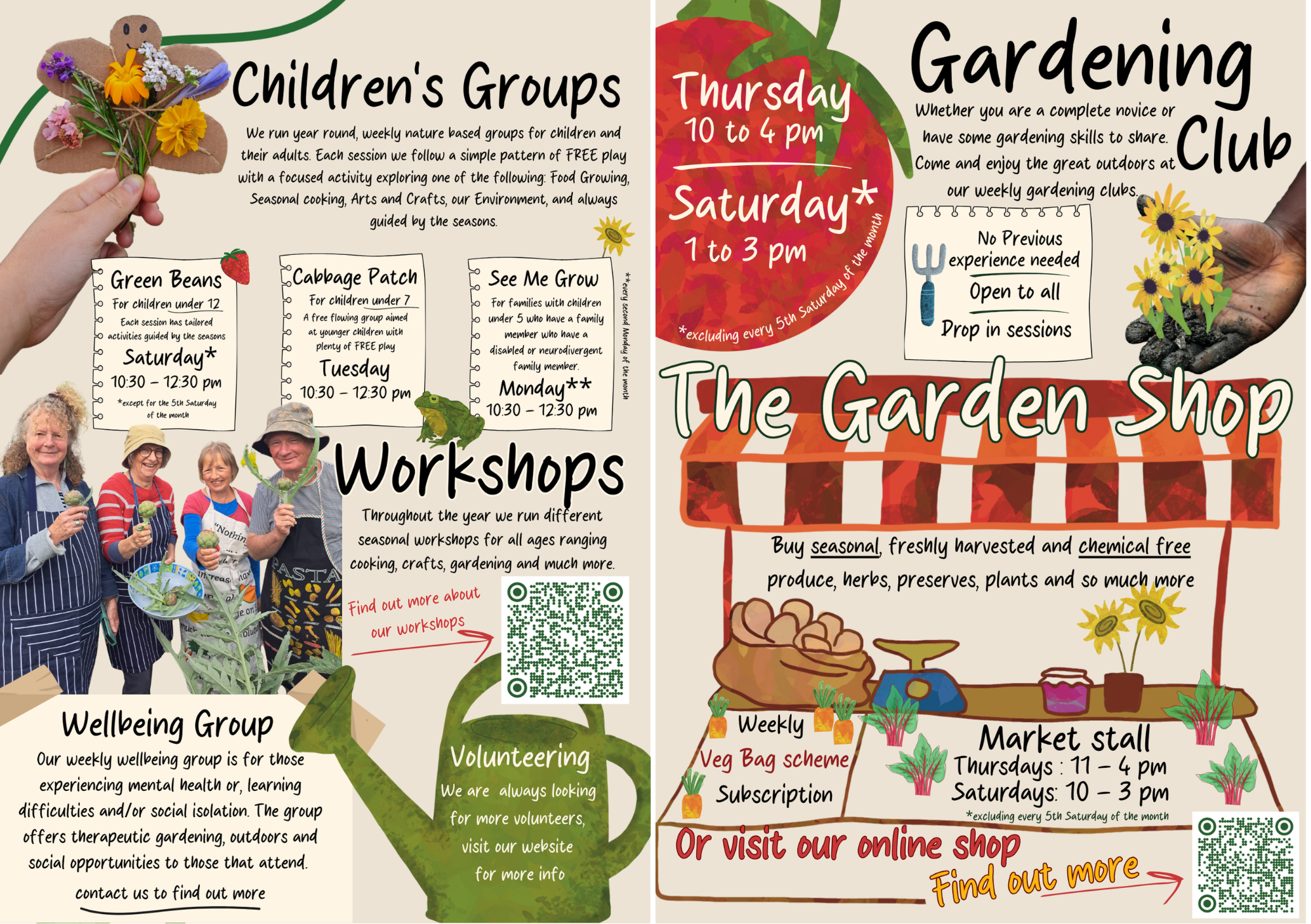
Look for references to people’s ages, interests or needs. In the gardening leaflet, “for children under 7” speaks to parents and carers, while “no previous experience needed” reassures beginner gardeners.
These phrases don’t just give information. They help particular readers feel welcome.
Look at the images
Ask who might find each image appealing. The flower-covered cardboard figure suggests a fun activity for children, while the illustrated market stall draws attention to products shoppers might want.
Be careful, though: an image of a particular group doesn’t prove that they are the only audience. Look for language that supports your interpretation.
Notice what readers are invited to do
Does the text ask people to join, volunteer, donate or shop? Different invitations often reveal different audiences. And these groups can overlap—a parent might also be a gardener and a customer.
Check the layout
Separate headings can act like signposts. “Children’s Groups,” “Wellbeing Group” and “The Garden Shop” help different readers find what matters to them.
Bring it into your analysis
Rather than saying:
“The leaflet appeals to everyone.”
Try:
“The leaflet appeals to several groups within the local community. Its age-specific labels help parents find suitable activities, while ‘no previous experience needed’ makes the Gardening Club feel accessible to beginners.”
The trick is to go beyond naming the audience. Show what in the text makes each group feel addressed—and why that matters to its purpose.
Two Ways to Structure Your Paper 1 Response on Multiple Audiences
For an IB English A Paper 1 guiding question about multiple audiences, you can organise your response in two ways:
By audience: Dedicate each body paragraph to a different audience, explaining how both textual and visual choices appeal to that group.
By technique: Organise your paragraphs around visuals, language and structure, explaining how each appeals to different audiences.
Both approaches work. The key is to keep linking your evidence to who is being addressed, how they are targeted and why—rather than simply listing audiences or techniques.
Paper 1—Leaflet & Essay
Guiding Question: How do the leaflet’s visual and textual features work together to appeal to multiple audiences?
The leaflet’s visuals appeal to multiple audiences by giving families, adults seeking social connection and potential shoppers different points of interest. The colourful craft imagery of the flower-covered cardboard figure is particularly suited to children and families. It offers a glimpse of a nature-based activity, making the children’s groups feel fun rather than formal. Alongside this playful image, the group photograph of smiling adults holding vegetables appeals to people seeking practical activities or companionship. Their expressions suggest an enjoyable shared experience, reinforcing the leaflet’s welcoming tone. The product illustrations of vegetables, preserves and flowers beneath the market stall’s striped canopy extend this appeal to shoppers. These recognisable images communicate the shop’s variety at a glance. Together, the visuals give different readers something relevant to notice, although the abundance of decoration can compete with the smaller written details.
Building on these visual appeals, the leaflet’s language addresses multiple audiences by tailoring its reassurance and information to their different needs. The Gardening Club’s invitation, “whether you are a complete novice or have some gardening skills to share,” uses contrast and direct address to include both beginners and experienced gardeners. This makes joining seem less intimidating while suggesting that existing skills will be valued. The age-specific labels “for children under 12” and “for children under 7” take a more practical approach, helping parents and carers identify suitable activities quickly. Meanwhile, the Wellbeing Group’s reference to “mental health or, learning difficulties and/or social isolation” explicitly identifies people who may benefit from support. This wording clarifies the group’s purpose rather than expecting readers to infer who it is for. For shoppers, the three-part list “seasonal, freshly harvested and chemical free” shifts towards promotional language, highlighting desirable product qualities. The wording therefore develops the initial appeal of the images by giving each audience a specific reason to participate or buy.
To help these multiple audiences navigate the different opportunities, the leaflet’s structure directs each group towards the information most relevant to them. Large headings, including “Children’s Groups,” “Workshops” and “Gardening Club,” establish a clear visual hierarchy, enabling families, activity-seekers and gardeners to locate suitable opportunities without reading every section. This is useful in a leaflet promoting several services at once, although the especially large gardening and shop headings give those sections greater prominence than the wellbeing and volunteering information. Within the children’s section, three separate notebook-style panels organise the groups by name, age range and meeting time. Their repeated format makes comparison easier for parents and carers deciding which session suits them. The two-page division also broadly separates community activities on the left from gardening and shopping opportunities on the right, helping manage the leaflet’s multiple purposes. Once readers have found something of interest, QR codes accompanied by arrows and calls to action, such as “Find out more,” guide smartphone users towards further information.
Taken together, the visuals, language and structure allow the leaflet to address multiple audiences while maintaining a shared message of welcome. Its strongest feature is this emphasis on inclusion, presenting the organisation as a community space where people with different interests and needs can participate. However, its use of QR codes as prominent routes to further details also raises the wider issue of digital inequality: readers without internet access or digital confidence may find it harder to follow up on their interest. The leaflet therefore succeeds in inviting a broad community, while revealing that a welcoming message alone does not guarantee equally accessible information.